- Home
- Manufacturing
AI in Manufacturing for Plant Operations and Maintenance
DigiWeta develops AI solutions for manufacturing teams working with inspection, maintenance, scheduling, and inventory data. We assess plant systems, operating conditions, data quality, and integration needs, then define evaluation criteria and review responsibilities before implementation.
- Plant-focused AI models
- Defined evaluation criteria






What We Build (Solutions & Use Cases)
Our manufacturing AI services connect machine learning, application development, and plant-system integrations. We define the intended workflow, available data, operating constraints, and evaluation criteria before building and testing the solution.
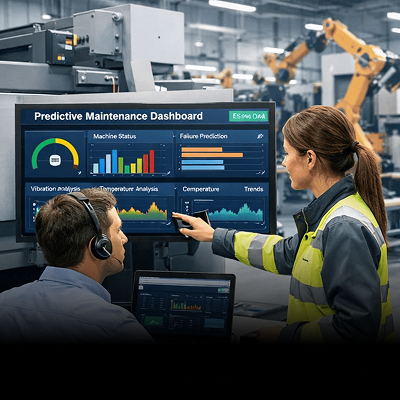
Predictive Maintenance
Analyze equipment signals and maintenance records to identify potential failures, with evaluation criteria and review workflows tailored to asset conditions.
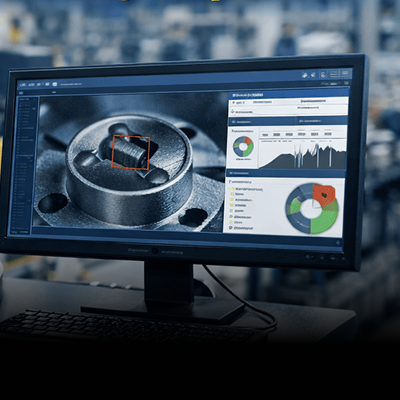
Vision Quality Inspection
Evaluate images for defined defect classes using representative production examples, agreed thresholds, and operator review of uncertain or flagged results.

Demand Forecasting and S&OP
Build demand forecasts using sales, seasonality, and production data, with error measurement and uncertainty ranges to support planning.

Smart Production Scheduling
Model production schedules around capacity, changeovers, and maintenance constraints, then compare alternatives with the team before implementation.
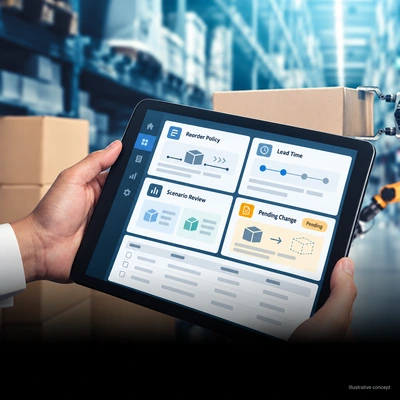
Inventory Optimization
Assess reorder policies using demand forecasts, lead times, and service targets, with scenario comparisons and review before changes reach inventory systems.

Connected Worker Safety
Evaluate defined hazard signals and route alerts for human review, with requirements and limitations assessed by relevant plant and safety specialists.
Architecture, Safety, and Evidence for AI at Plant
Manufacturing AI needs clear data definitions, representative operating examples, and evaluation that reflects the intended production environment. DigiWeta reviews source systems, equipment signals, workflow constraints, and integration dependencies before implementation. We agree acceptance criteria and document assumptions so the team can assess model results and limitations.
Release planning considers line speed, connectivity, maintenance windows, and operator review. The scope can include data pipelines, edge or cloud processing, application integrations, and monitoring. Failure handling, recovery, and operating responsibilities are documented, with relevant plant and safety specialists reviewing requirements before deployment.
Strategy, Guardrails, and KPI Alignment
We connect OEE, first-pass yield, MTBF, and service targets to model thresholds, tolerances, and change windows. Safety assumptions, escalation rules, and operator checkpoints become acceptance criteria, with code and dashboards recording governance rather than relying on last-minute emails.
- Translate business goals into target deltas: scrap reduction, uptime increase, changeover minutes, kWh per unit; define tolerances and SLOs per line and product family.
- Set decision thresholds using model metrics including critical-defect recall, lead time bias, and maintenance windows; provide reason codes for operator review.
- Document constraints: regulatory, safety, shift coverage, tooling, energy tariffs; align exception handling and escalation with EHS and production leaders.
- Include cloud solutions for manufacturing to standardize identity, encryption, DR, and cost governance across plants and regions.
TECH STACK :
Socket.io
Redis Pub/Sub
Node.js Cluster
Nginx
PostgreSQL
Bull MQ
Data Contracts and Feature Governance
We define data contracts for PLC tags, historians, MES, CMMS, and ERP. These specify meaning, timing, relevant PHI/PII classifications, and SLAs. Leakage checks and timestamp controls help identify upstream changes that could affect model accuracy or operator confidence.
- Specify versioned data contracts covering schema, units, sampling rates, missing values, and retention, with checks before training and inference.
- Engineer feature pipelines with versioned transformations, windowing, and leakage prevention; expose lineage, freshness, and drift with owners and SLAs.
- Apply privacy by design for operator and supplier data; audit access continually; document approved uses and retention aligned to policy and law.
- Organize plant analytics through data warehousing, documenting shared definitions, source ownership, and lineage.
TECH STACK :
Socket.io
Redis Pub/Sub
Node.js Cluster
Nginx
PostgreSQL
Bull MQ
Modeling, Explainability, and Safety Cases
Model selection considers accuracy and explainability. We use interpretable methods where needed and ensembles where oversight supports them, evaluating performance at relevant thresholds. Operator explanations, safety cases, change logs, and model cards document assumptions, limitations, mitigations, and release approvals.
- Choose models for the task: anomaly detection for assets and supervised models for defects; evaluate calibration as recipes and suppliers change.
- Link model explanations to operator decisions using feature attributions, example images, and notes; collect feedback for review and retraining.
- Validate fairness where people are in loop (safety alerts, rostering); document mitigations and signoffs from EHS and HR where applicable.
- Structure MLOps model deployment around approval steps, shadow tests, canary releases, and documented drift triggers.
TECH STACK :
Socket.io
Redis Pub/Sub
Node.js Cluster
Nginx
PostgreSQL
Bull MQ
Edge, Latency, and Line Speed
Where response times require it, we deploy models on edge devices or gateways. Batching, caching, runtime sizing, and graceful degradation address traffic spikes, lost connectivity, and constrained dependencies, with production continuity and operator workload considered in the design.
- Test low latency feature services with timeouts, retries, and fallbacks, measuring behavior during inference bursts and slower dependencies.
- Define idempotent state machines for vision and maintenance events, separating alerts from actions and documenting state recovery after outages.
- Validate on representative hardware; automate tests for jitter, clock skew, packet loss; certify minimum viable performance before release.
- Use AI application development to package decision services with interfaces, telemetry, and procedures across plants.
TECH STACK :
Socket.io
Redis Pub/Sub
Node.js Cluster
Nginx
PostgreSQL
Bull MQ
CI/CD, Safety Reviews, and Evidence
Data checks, evaluation thresholds, approvals, and promotion rules govern releases. We sign artifacts, attach audit packs, and rehearse rollback. Champion–challenger, shadow, and canary methods support reversible updates, while dashboards link model decisions to OEE, scrap, and energy KPIs.
- Configure pipelines to check data contracts and features, train and evaluate models, then compare metrics, explanations, and approvals against documented promotion criteria.
- Run shadow and canary with observation windows sized to risk; gate promotion on golden signals: FPY, false reject rate, downtime minutes avoided.
- Generate SBOMs; sign artifacts; verify signatures at promotion; keep immutable traces from requirement to release for auditors.
- Align with maintenance and production change windows; publish risk memos; ensure on-call and escalation are staffed before cutover.
TECH STACK :
Socket.io
Redis Pub/Sub
Node.js Cluster
Nginx
PostgreSQL
Bull MQ
People, Change, and Continuous Improvement
Operators and engineers help shape the workflow, review explanations, and provide feedback. Logged actions, playbooks, training, and shared dashboards make ownership and improvements visible. Retrospectives and incident reviews identify changes needed to support safety and performance.
- Design UI surfaces for clarity: thresholds, confidence, and next steps; avoid alarm fatigue with tuned alerts and SLO-backed paging.
- Route exceptions with ownership and SLAs; collect operator feedback as labeled data for retraining; surface live error taxonomies.
- Track improvements: downtime saved, defects avoided, energy reduced; tie to incentives and continuous improvement rituals.
- Maintain ADRs and change logs for plant, IT, and quality teams, recording responsibilities, handoffs, and decisions as operating requirements change.
TECH STACK :
Socket.io
Redis Pub/Sub
Node.js Cluster
Nginx
PostgreSQL
Bull MQ
Why Manufacturing AI Projects Struggle and How DigiWeta Helps
Manufacturing pilots can behave differently when materials, equipment settings, lighting, or product mixes change. Inconsistent timestamps and unclear data definitions can also make model results difficult to assess. A useful implementation needs representative examples, agreed evaluation criteria, and a plan for uncertain or failed outputs.
DigiWeta reviews these requirements with the relevant plant and technical teams before development. We plan data preparation, application integrations, testing, monitoring, and recovery around the agreed workflow. Findings, assumptions, and limitations are documented, while release and handover steps reflect operating constraints and maintenance priorities.
No Data Contracts Across PLC, MES, CMMS
Define data contracts across PLC, MES, and CMMS systems, with checks for signal meaning, timestamps, and lineage. Review feature inputs for leakage and timing errors before evaluation. Use AI integration services to document interfaces and coordinate changes across vendors and plants.
Vision Models Without Operations Alignment
Evaluate vision models at agreed inspection thresholds, then review flagged results and operator feedback. Document decision reasons and pipeline requirements. Connect model outputs and review screens through back-end development services, with defined interfaces and performance tests.
Manual Releases and Risky Rollbacks
Plan model releases around approval gates, shadow tests, canary stages, and rollback criteria linked to OEE and FPY. Apply DevOps development services to document CI checks, artifact signing, and promotion steps.
Untuned Latency at the Edge
Measure model response times under representative line conditions. Test batching, backpressure, and fallback behavior across devices and connectivity changes. Use software QA testing to record jitter, latency, and recovery findings before deployment decisions.
Predictors That Ignore Seasonality or Mix
Review forecasts as product mix, suppliers, and promotions change. Compare scenarios, recalibration results, and uncertainty ranges so procurement and S&OP teams can assess predictive modeling assumptions before planning decisions.
Automation Without Human Oversight
Unbounded automation can harm quality and morale. We add human-in-the-loop checks, reason logs, and SLAs. For back office and plant workflows with strong controls and audit trails, adopt intelligent process automation patterns.
Computer Vision Without Safety Case Evidence
Lacking model cards and approvals stalls audits. We produce model cards, fairness (where relevant), evaluation snapshots, and signed artifacts for each release. When imaging is central, our computer vision solutions bring de-identification, bias tests, and review gates.
Fragmented Apps and Operator Experiences
Map operator tasks across existing tools, then simplify shared components and navigation. Coordinate interfaces with frontend development, defining accessibility checks, performance budgets, and usability tests around representative plant workflows.

Flexible Engagement Models for Manufacturing
Scale at your pace with governance intact. Whether you need a governed pilot uplift, a pod delivering multi-plant outcomes, or specialists for audits and incidents, you retain IP, repos, and control while we supply SLOs, engineering rigor, and transparent reporting.
Fixed Scope AI Uplift
Blueprint to governed pilots, rapid handover
Best For
- Data and feature contracts
- MLOps and approvals
- Line-ready pilot
Advantages
- Fast time to value
- Evidence and signoffs
- Safer small releases

Dedicated Manufacturing AI Squad
Cross functional pod delivering safe velocity.
Best For
- Roadmap execution
- Scale and resilience
- Multi-plant rollouts
Advantages
- Continuous improvement
- SLO stewardship
- Cost optimization

Advisory and Augmentation
Specialists for audits, incidents, surges.
Best For
- Audit preparation
- Incident response
- Team enablement
Advantages
- Rapid onboarding
- Flexible capacity
- Reduced risk
WE SERVE
AI Capabilities for Manufacturing
Our manufacturing technology work can connect equipment signals, production records, and operational applications. We define source requirements, integration behavior, evaluation criteria, and review responsibilities around your assets, lines, and maintenance needs.
Build retrieval augmented generation using approved manuals, SOPs, and change logs for troubleshooting, training, and documentation. Define prompt controls, redaction rules, and approval steps, then test responses with relevant plant teams.
Automate repetitive back office and plant workflows with checkpoints, reason logs, and SLAs. Every decision writes evidence; exceptions route with owners and timelines. Cycle times drop without sacrificing compliance or quality.
Integrate models with PLCs, historians, MES, CMMS, and ERP using versioned contracts, signed webhooks, retries, and DLQs. Monitor failed requests and vendor changes, with documented recovery steps and ownership.
Automate inline defect detection, classification, and measurement with bias tests, de‑identification, and human review gates. Operator feedback improves precision while audit logs preserve evidence for quality and regulatory reviews across products and sites.
Model equipment failures, scrap risk, demand, and cycle time using available plant data. Document uncertainty and calibration results, then compare scenarios for S&OP and maintenance planning.
Manage model updates with versioned datasets, approvals, shadow tests, and canary rollouts. Document drift alerts, rollback triggers, and evaluation records so teams can review release behavior and operating assumptions.
HOW IT WORK
Our Manufacturing Delivery Process
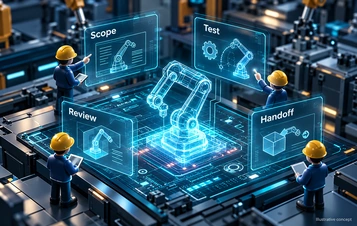
We scope manufacturing AI around a defined workflow, available data, and operating constraints. Each phase covers preparation, integration, testing, and review, with acceptance criteria, documented limitations, and responsibilities for release and monitoring.
Step 01
Discovery and Blueprint
Discovery and Blueprint
We map OEE, FPY, MTBF, and service targets to plant KPIs and maintenance windows. Discovery defines fairness and safety budgets, then establishes data contracts, feature governance, model requirements, approvals, change cadence, and SLOs.
Step 02
Architecture and Implementation
Architecture and Implementation
We build feature pipelines, training/evaluation, and real-time decision services for edge or cloud deployment. CI/CD applies checks, thresholds, and approvals. Supervised shadow and canary tests evaluate behavior, with reason codes and model cards per build.
Step 03
Hardening and Readiness
Hardening and Readiness
We test latency, drift, cost, and applicable fairness criteria, rehearse rollback, and complete performance and control dashboards. Evidence packs support audits and customer reviews. Runbooks identify incident owners, escalation routes, and plant safeguards.
Step 04
Launch and Optimization
Launch and Optimization
We launch through canary releases, monitoring OEE, FPY, downtime, and energy. Drift alerts and rollback triggers remain active. Tests and telemetry inform threshold, feature, and UX changes, while SLO, DORA, and P&L reviews guide priorities.

ABOUT DIGIWETA
Your Trusted AI Partner for Manufacturing
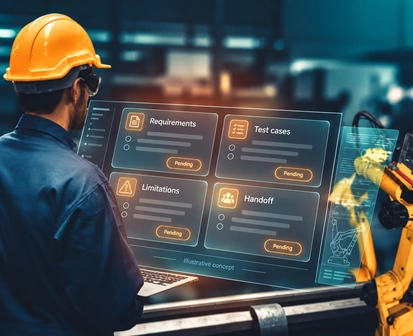
DigiWeta develops AI for manufacturing workflows. We connect data, models, and plant applications around defined requirements, then test the agreed scope and document operating responsibilities, limitations, and review needs before deployment.
- Architecture first, KPI aligned delivery
- Data contracts and feature governance
- Explainable, monitored models and thresholds
- MLOps with canary and rollback
- Evidence packs auditors accept
Process Automation Efficiency
0
%
Intelligent Decision Support
0
/7
Frequently Asked Questions
The program covers discovery, governance, data contracts for PLC, MES, CMMS, ERP and historians, feature pipelines, and explainable modeling. MLOps includes approvals, shadow/canary releases, and rollback. Real-time decisions have latency and inference-cost budgets. Each release includes model cards, evidence packs, and OEE, FPY, and energy dashboards.
We embed operator-in-the-loop checkpoints, escalation paths, and reason codes. Thresholds anchor to business and safety tolerances. Safety cases, model cards, and approvals accompany releases. Latency budgets, graceful degradation, and rollback prevent disruption. Continuous monitoring and post-incident reviews sustain trust and performance.
Inline vision for defect detection, predictive maintenance on critical assets, and SKU/site-level demand forecasting typically return value within quarters. We prioritize by impact and feasibility, then expand to scheduling and inventory optimization once data contracts and feedback loops are stable.
Versioned contracts, signed webhooks, retries, and dead-letter queues govern data exchange and failures. Sandboxes and monitoring identify partner changes and uptime issues. We coordinate cutovers with maintenance schedules to limit disruption to production and operators.
We assess models at business thresholds and route uncertain cases for operator review. Feedback informs improvements. Testing covers lighting, camera placement, inference jitter, and representative hardware, with limitations and mitigations recorded in model cards.
We baseline scrap, uptime, changeovers, and energy, then compare outcomes through experiments or A/B-style tests by line or product family. Reports attribute incremental improvements by cohort and site, alongside DORA, SLOs, drift, and cost per decision to assess delivery health.
Yes. We deploy inference at gateways or on-device where milliseconds matter, and centralize training, governance, and analytics in the cloud. We rightsize compute, cache smartly, and use policy as code for identity, encryption, DR, and budgets, ensuring predictable performance and compliance.
Input, feature, and outcome monitoring helps identify drift. We schedule recalibration and use champion–challenger comparisons and shadow routing to test changes. Diagnostics assess shifts in product mix, suppliers, and seasonal demand. Policy determines retraining, with evidence and approvals required for promotion.
Ready to Operationalize Manufacturing
Plan AI for inspection, maintenance, scheduling, and inventory around plant data and operating needs. Define evaluation criteria, review responsibilities, and integration requirements before implementation.