- Home
- MLOps & Model Deployment
MLOps Consulting Services for Model Operations
Move model work into repeatable release and operating processes. DigiWeta’s MLOps consulting services connect data pipelines, evaluation, deployment, and monitoring with clear ownership around your infrastructure and applications.
- Defined platform and access scope
- Assessed deployment options
Scope an MLOps Project
Which model task is next?








MLOps Uses Across the Model Cycle
Build a practical path from model development to ongoing operation. Our MLOps services define artifact versions, evaluation gates, deployment checks, and incident duties around your existing team and systems.
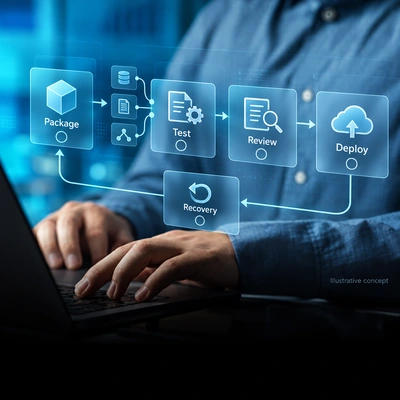
AI Model Deployment Services
Package and deploy models against defined workload targets. Test dependencies, scaling, release checks, and recovery before exposing applications to changes.
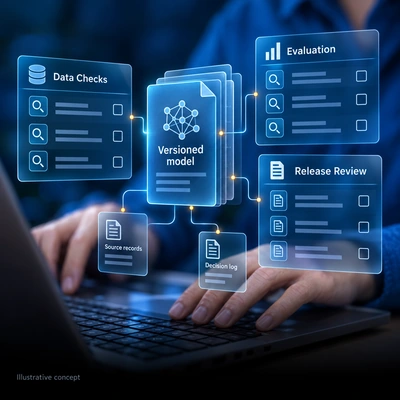
ML Release and Evaluation Gates
Connect data checks, model evaluation, and release approvals. Keep artifacts and decisions traceable across development and deployment.

Feature and Data Workflows
Define reusable features, update rules, and data contracts. Test training-serving consistency and point-in-time correctness where the task requires it.

Model Monitoring and Incident Review
Monitor service behavior and relevant model outcomes. Investigate shifts, assign incidents, and review evidence before changing or retraining models.

Governance, Security, and Compliance
Restrict access to data, artifacts, and deployments. Define review records and qualified assessment of requirements for the intended use.
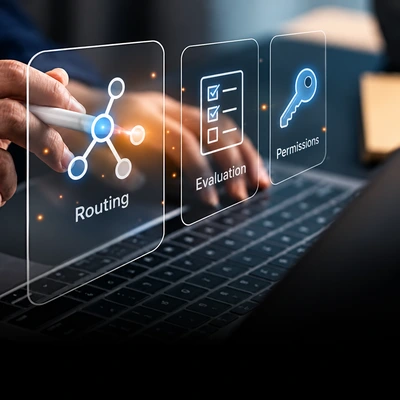
Multi-Model and Agent Operations
Scope model routing around features, data handling, evaluation, and tool permissions. Test the complete agent workflow.
MLOps Architecture
Pipelines and Model Review
Review how data, features, code, artifacts, and configuration reach production. Define acceptance criteria and the people responsible for promotion, operation, and recovery. Scope repeatable pipelines and useful evidence around the actual application. Explore AI Strategy Consulting for planning.
Plan monitoring alongside deployment. Identify signals that operators can act on, including input quality, application failures, latency, costs, and model outcomes where available. Define escalation, review, and recovery procedures. Document limits and handover duties. Related application work includes LLM Development Services.
Architecture and Platform Blueprint
Match the platform to your data and operating team. Define artifact versions, configuration, release duties, and recovery. Assess dependencies and maintenance before adding new tools.
- Select training, artifact, and serving components against workload needs, team skills, and maintenance costs.
- Version dependencies and build inputs. Record provenance and test reproducibility within documented limits.
- Define tests and approval responsibilities for environment promotion, with clear acceptance criteria.
- Review infrastructure changes as versioned configuration and test deployment and recovery procedures.
TECH STACK :
Socket.io
Redis Pub/Sub
Node.js Cluster
Nginx
PostgreSQL
Bull MQ
Data and Feature Governance
Define feature sources, time semantics, transformations, and update ownership. Test consistency between development and serving. Investigate missing or changed data before assuming a model update will solve the problem.
- Define feature transformations, timing, freshness, and owners. Test training-serving consistency.
- Validate data schemas and source lineage. Route missing or conflicting inputs to responsible owners.
- Investigate input and outcome changes before deciding whether retraining or threshold changes are appropriate.
- Assess sensitive-data recipients, access, and retention across training and serving workflows.
TECH STACK :
Socket.io
Redis Pub/Sub
Node.js Cluster
Nginx
PostgreSQL
Bull MQ
Model CI/CD and Testing
Use evaluation and application tests to support release decisions. Compare relevant data slices and realistic failures against agreed criteria. Record approvals and limitations, then test rollout and recovery behavior before wider exposure.
- Test code, data, and packaging with versioned artifacts and relevant provenance records.
- Evaluate representative data slices and failure scenarios against intended use and error consequences.
- Test proposed models without unintended downstream side effects, then compare quality, latency, and costs.
- Use agreed evaluation and service criteria to support documented deployment decisions.
TECH STACK :
Socket.io
Redis Pub/Sub
Node.js Cluster
Nginx
PostgreSQL
Bull MQ
Integrations and Data Contracts
Define validated inputs, outputs, permissions, and failure behavior for model consumers. Test version changes and downstream actions together, with ownership of rejected or unresolved requests.
- Define schemas, units, versions, and source metadata for model inputs and outputs. Validate application assumptions.
- Handle delayed events, duplicate requests, and partial completion. Check uncertain results before retries.
- Use verified identities and scoped access for model consumers. Review permissions and attribution.
- Test mappings, version compatibility, and downstream effects before releasing changes.
TECH STACK :
Socket.io
Redis Pub/Sub
Node.js Cluster
Nginx
PostgreSQL
Bull MQ
Serving and Orchestration
Choose serving around workload and operating needs. Test spikes, timeouts, and dependencies. Define recovery limits; not every release or completed action can be reversed.
- Assess managed or self-operated serving against workload, resources, provider limits, and team capacity.
- Test routing and fallback compatibility, quality, and approved data recipients before use.
- Define timeouts, retries, and duplicate handling, with recovery for unresolved outcomes.
- Document consumer interfaces and required validation, permissions, and monitoring.
TECH STACK :
Socket.io
Redis Pub/Sub
Node.js Cluster
Nginx
PostgreSQL
Bull MQ
Observability, FinOps, and SLOs
Connect service metrics to relevant model and business outcomes. Make costs and failures visible to operators. Prioritize work using evidence, not dashboards alone.
- Monitor useful service signals and model outcomes with appropriate access and retention.
- Review data quality and distribution changes as investigation signals, not automatic proof of lost accuracy.
- Measure complete operating costs and set appropriate budgets and limits by workload.
- Tie service targets to application needs and use failures to prioritize changes.
TECH STACK :
Socket.io
Redis Pub/Sub
Node.js Cluster
Nginx
PostgreSQL
Bull MQ
Security, Risk, and Compliance
Map access, recipients, artifacts, and deployment permissions. Test controls with qualified stakeholders. Infrastructure alone does not establish compliance or guarantee approval.
- Define access boundaries, secret handling, and data safeguards across development and serving.
- Restrict connected tools and recipients; test sensitive-data handling and misuse scenarios.
- Keep relevant model, approval, and deployment records for qualified review.
- Test relevant dependency failures and misuse, with clear incident ownership and recovery duties.
TECH STACK :
Socket.io
Redis Pub/Sub
Node.js Cluster
Nginx
PostgreSQL
Bull MQ
Strengthen ML Pipelines with Operating Controls
A notebook result does not define how an application should operate. Missing versions, inconsistent features, and unclear release ownership make failures harder to investigate. Agree evaluation, deployment, and recovery requirements alongside the model’s intended use, with a baseline for quality, response time, and cost.
DigiWeta scopes MLOps around these gaps. Map the current workflow, establish testable acceptance criteria, and build the agreed pipeline, serving, and monitoring components. Keep limitations and operating duties documented so your team can assess changes and maintain the application after handover.
Model Registry and Catalog
Organize model artifacts with versions, owners, dependencies, and intended uses. Define promotion checks and access rules before migration. Verify that applications resolve the correct artifact and that operators can trace a deployment to its evaluated inputs and configuration.
Feature Workflow Delivery
Define feature sources, transformations, time semantics, and update duties. Test offline and online behavior where both are needed. Document missing-data handling and ownership. A feature store can support reuse, but it does not automatically prevent leakage or drift.
Controlled Release Tests
Assess shadow, staged, or comparative releases against the application’s risks and data needs. Prevent unintended writes during tests. Compare outcomes and costs, then document promotion or recovery decisions. Rollback depends on deployment state and does not undo every downstream effect.
Model Evaluation Suite
Evaluate intended tasks and error consequences on representative data. Record test versions and criteria. Review gaps as use changes, then retest releases; a passing suite does not cover every production scenario.
Incident and Service Review
Agree service targets, alert owners, and investigation steps. Practice relevant recovery procedures and document limitations. Review incidents to improve tests and operating guidance rather than treating alerts as automatic fixes.
LLMOps Review
Version prompts, retrieval settings, models, and tool contracts. Test answer support, permissions, and action outcomes separately. Review source changes and failures before release. Model fluency or successful tool invocation does not establish a correct task result.
Training and Handover
Document platform use, releases, and incident duties. Agree training, handover, and ownership of tests and operating guidance.
Outcome and Cost Reporting
Connect relevant metrics to supported business outcomes. Include costs and review effort, and separate observations from estimates. Use evidence to guide priorities.
Choose Delivery Support for
MLOps Delivery
Choose support around your model workflow, internal capacity, and operating needs. Agree scope, tests, costs, responsibilities, and handover for a complete project, managed support, or embedded expertise.

Complete MLOps Delivery
Plan, build, test, and hand over model operations.
Best For
- New or revised model platforms
- Governed settings
- Regional deployment
Advantages
- Clear delivery ownership
- Defined controls and review
- Measured task outcomes

MLOps as a Service
Scope managed training, deployment, monitoring, and operational review duties.
Best For
- Team capacity gaps
- Ongoing model changes
- Defined service targets
Advantages
- Visible operating costs
- Measured model quality
- Agreed support and incident duties
Embedded MLOps Team
Add data, serving, and testing expertise to your team.
Best For
- Parallel workstreams
- Internal model platforms
- Incident review and improvement
Advantages
- Flexible support
- Practical handover
- Agreed delivery milestones
SECTORS
Industry Workflows with
MLOps
MLOps requirements vary with the model’s intended use and consequences of errors. Define data, infrastructure, permissions, evaluation, and operating review for the application. Involve qualified stakeholders where sector or high-impact requirements apply.
Support financial model operations with appropriate data, evaluation, and review. Keep consequential decisions with qualified authorized staff.
Scope healthcare model operations with clinical and privacy specialists. Define intended use, evaluation, access, and qualified review.
Evaluate retail model changes against representative demand and operating outcomes. Review data shifts, costs, and consequential actions.
Operate planning and quality models with defined release and incident duties. Retain qualified review for consequential decisions.
Evaluate model and agent releases against application needs, access boundaries, and complete task outcomes, with clear operating ownership.
Define evaluation, data access, and review for property models. Keep consequential housing or valuation decisions with qualified authorized staff.
OUR PROCESS
Our MLOps Delivery Stages
Assess the current workflow, build a bounded implementation, and review evidence before rollout. Agree milestones, acceptance criteria, incident duties, and handover so progress and unresolved findings remain visible.
Step 01
Scope and Baseline
Scope and Baseline
Map data, artifacts, infrastructure, and responsibilities. Establish quality, latency, and cost baselines with agreed acceptance criteria.
Step 02
Build and Test
Build and Test
Build the scoped pipelines, registry, serving, and tests. Review release and recovery behavior before wider deployment.
Step 03
Connect and Expand
Connect and Expand
Validate added models, consumers, and teams before expansion. Recheck contracts, permissions, costs, and operating ownership.
Step 04
Review and Maintain
Review and Maintain
Review service targets, model outcomes, and data changes. Test proposed updates and investigate drift before deciding to retrain.

ABOUT US
Your MLOps Partner
DigiWeta helps teams connect model development to release and operating processes. Define pipelines, evaluations, deployment checks, and incident duties around your application. Related integration work includes API Development and Integration.
- Versioned pipelines and artifacts
- Tested serving and recovery
- Model, data, and cost review
- Requirements assessed by scope
- Defined owners and runbooks
Success Rate
0
%
Satisfied clients
0
%
Frequently Asked Questions
It can cover data and feature workflows, artifacts, evaluation, deployment, monitoring, and operating duties. Agree which stages are included and how readiness is assessed. The scope should fit the application and team rather than imply every platform component is necessary.
Managed support assigns agreed operating duties to the provider; embedded expertise adds capacity alongside your team. Define included tasks, service targets, access, and escalation in either model. Neither arrangement guarantees fixed costs or model performance.
Assess both against response needs, volumes, dependencies, and costs. Define packaging, scheduling or serving, validation, and recovery. Test the complete application; deployment techniques do not make every change reversible.
Define model routing, retrieval, and tool dependencies with explicit permissions and evaluation. Test full task outcomes and failure behavior. Related architecture work includes AI Agents Development.
Compare workload, data handling, infrastructure, operating skills, and costs. Assess hosted, private, or hybrid options against actual dependencies and requirements. Hosting location and access controls alone do not establish regulatory compliance.
Investigate input and outcome changes using representative tests and application evidence. Review before retraining or changing thresholds. Drift alerts signal a need to assess, not proof of failure or a guaranteed fix.
Measure complete workload costs, including infrastructure, provider calls, pipelines, and support. Set appropriate limits and compare optimization changes against quality and service needs rather than assuming stable unit costs.
Assess source contracts, permissions, required operations, and failure handling. Test mappings and version changes. Related infrastructure options include Cloud Solutions.
Plan Model Operations with DigiWeta
Discuss your models, data workflows, infrastructure, and operating gaps with DigiWeta. Define a practical MLOps scope and measurable release criteria.