
- Home
- Speech-to-Text & Voice AI
Speech to Text Services for Enterprise Voice AI
Turn approved audio into transcripts, reviewable summaries, and connected workflows. DigiWeta’s speech-to-text and voice AI services start with your languages, recording conditions, privacy needs, and the tasks your team must complete.
- Defined audio and access scope
- Tested streaming workflows
Scope a Voice AI Project
Which voice task is first?








Voice Uses Across Business Teams
Connect speech recognition, responses, and supported application tasks around the caller’s needs. Define call flows, access, recording choices, and staff handoffs. Test the complete experience using representative audio before rollout.

Speech to Text for Customer Service
Transcribe approved calls, prepare summaries, and suggest structured notes. Review critical details before they become CRM records or actions.

AI Voice Answering Service
Identify requests, gather relevant details, and route callers. Use defined verification and staff handoffs for sensitive or unsupported tasks.

Voice Agents for Business Tasks
Support appointment requests, order queries, and approved knowledge answers. Confirm important details and transfer unresolved requests to staff.
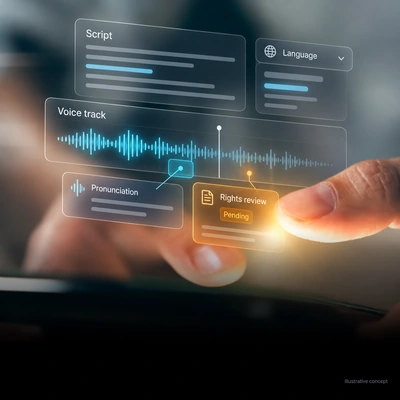
Voice Over and Localization
Prepare approved scripts and voice tracks. Review pronunciation, language, rights, and intended use before publishing.

AI Voice Bots for Customer Service
Connect caller requests to approved sources and permitted tools. Validate actions and give staff the context needed to continue.

Voice Search and Query Analytics
Review permitted voice queries and task outcomes. Use failures to improve prompts, search results, and supported commands.
Voice AI Architecture
Audio, Transcripts, and Actions
Evaluate recognition and synthesis against the audio your users actually produce. Include relevant languages, accents, noise, and call channels. Define success criteria for transcription, critical details, response time, and complete tasks. Related application work includes LLM Development Services.
Map where audio, transcripts, and summaries are sent and retained. Define access, recording choices, review, and appropriate safeguards before connecting systems. Plan interruption handling, failed actions, and staff transfer. Have qualified stakeholders assess applicable recording, privacy, and industry requirements for the intended deployment.
Speech and Language Stack
Compare speech engines using representative audio rather than general accuracy claims. Test vocabulary, speaker labels, timing, and critical entities separately. Review errors that could affect downstream tasks before selecting the recognition and response stack.
- Evaluate cloud and local recognition options against your audio, languages, data handling, and task requirements.
- Test supported vocabulary adaptation on important names and terms; measure both corrections and new errors.
- Choose streaming or batch processing around timing needs. Check transcripts, timestamps, and incomplete audio.
- Validate extracted names, numbers, and record matches before writing them to connected systems.
TECH STACK :
Socket.io
Redis Pub/Sub
Node.js Cluster
Nginx
PostgreSQL
Bull MQ
Enterprise Integrations
Define how transcripts and summaries become CRM notes, service cases, or tasks. Map fields, permissions, validation, and review. Check actual update results and handle duplicates or uncertain outcomes before retrying.
- Assess CRM, ITSM, warehouse, and telephony interfaces against required permissions and operations.
- Define field mappings, accepted values, ownership, and review for summaries or extracted details.
- Handle delayed events, duplicates, provider limits, and uncertain updates explicitly. Check outcomes before retries.
- Test mappings and failure cases using approved audio and records. Explore related API Development and Integration capabilities.
TECH STACK :
Socket.io
Redis Pub/Sub
Node.js Cluster
Nginx
PostgreSQL
Bull MQ
Security, Governance, and Compliance
Map audio and transcript recipients, access, and retention. Apply appropriate safeguards and review requirements. Test sensitive-data handling rather than assuming automated redaction removes every private detail.
- Review recording choices and data handling. Test redaction and apply appropriate access and retention.
- Restrict exports and tool actions using verified permissions, with review for consequential changes.
- Keep suitable review records and assess controls with qualified stakeholders for the intended use.
- Test transcript-based prompt injection and inappropriate disclosure in connected model workflows.
TECH STACK :
Socket.io
Redis Pub/Sub
Node.js Cluster
Nginx
PostgreSQL
Bull MQ
Observability and Voice MLOps
Measure transcription errors, critical-detail accuracy, latency, and costs with representative recordings. Compare changes against the baseline and keep deployment, review, and recovery responsibilities clear.
- Monitor recognition versions, failures, latency, and usage costs alongside relevant task outcomes.
- Use representative recordings by language, channel, and audio condition to assess changes.
- Test engine, vocabulary, and processing updates before rollout, with documented recovery procedures.
- Review complete call costs and operating limits. Related telephony work includes Voice AI and IVR Solutions.
TECH STACK :
Socket.io
Redis Pub/Sub
Node.js Cluster
Nginx
PostgreSQL
Bull MQ
Performance and Scale Engineering
Test concurrent calls, provider limits, interruptions, and failed connections. Define queuing and staff fallback behavior. Set service targets around measured performance instead of assuming streaming guarantees responsiveness.
- Test concurrency, queues, timeouts, and provider limits against expected demand and failure conditions.
- Distinguish provisional transcript text from finalized results. Review critical details before actions.
- Test any provider routing for supported features, language quality, permissions, and approved recipients.
- Exercise interruption and recovery paths. Make failed or incomplete interactions visible to responsible operators.
TECH STACK :
Socket.io
Redis Pub/Sub
Node.js Cluster
Nginx
PostgreSQL
Bull MQ
Human-in-the-Loop QA and CX
Give reviewers relevant audio, timestamps, and proposed corrections. Check critical details before they trigger actions. Review feedback before changing vocabularies or models, and retest the affected call scenarios.
- Route critical or uncertain details for review; model confidence alone does not prove accuracy.
- Show relevant audio, timestamps, and proposed text so reviewers can verify important corrections.
- Review vocabulary or extraction changes and retest them before release; do not assume feedback guarantees improvement.
- Link summaries to supporting transcript passages and check material claims against the original audio.
TECH STACK :
Socket.io
Redis Pub/Sub
Node.js Cluster
Nginx
PostgreSQL
Bull MQ
- Tested operating targets
- Defined safeguards
Improve Speech and Voice Workflows with Real Audio Tests
Audio conditions matter. Accents, background noise, overlapping speech, and specialist terms can change recognition results. Test representative recordings and identify which errors matter to the task before using transcripts for summaries or system updates.
DigiWeta scopes recognition, call flows, validation, and handoffs as one workflow. Define review for uncertain details and verify action outcomes. Compare releases against agreed audio examples and operating measures. Explore MLOps and Model Monitoring for related support.
Audio Privacy and Review
Define recording notices, permissions, recipients, and retention. Test redaction and restrict original audio access. Review downstream copies and exports. Qualified stakeholders should assess requirements; a transcript tag alone does not establish consent or lawful use.
Speaker Labels and Turns
Test speaker separation on representative calls, including overlap and noise. Review labels before relying on attribution. Diarization distinguishes voices; it does not verify personal identity. Test interruptions and turn handling in the full caller experience.
Vocabulary and Key Terms
Identify important names, numbers, and specialist terms. Test vocabulary adaptation against representative recordings and a baseline. Review improvements and regressions before release, with extra checks where a misheard detail could change an action.
Structured Call Outcomes
Map candidate intents and details to agreed record fields. Validate critical values and request review where appropriate. Check summaries against transcript evidence, then verify permitted updates in the target system before retrying. Keep unresolved outcomes visible to responsible staff.
Multilingual Review
Test mixed-language audio and translated summaries with appropriate reviewers. Maintain terminology, source context, and unresolved details. Assess quality and data handling for the intended use rather than assuming equivalent performance across languages.
Staff Assist and Review
Use approved transcripts for guidance and draft notes. Give staff source context and correction options. Review automated scoring before consequential decisions. Measure actual work and caller outcomes rather than promising higher satisfaction or sales.
Low-Connectivity Audio
Assess local capture, storage, and later synchronization. Define device access and retention. Test incomplete uploads and distinguish provisional transcripts from reviewed records. Buffering does not guarantee complete evidence.
Synthesis and Dubbing
Use approved scripts and licensed voices. For AI voice cloning services, obtain the speaker’s informed authorization and meet provider requirements. Review pronunciation, rights, and intended use before publishing; do not misrepresent synthetic speech as an unauthorized recording.

Choose Delivery Support for Voice AI
Match delivery support to your call flows, audio, and systems. Agree scope, acceptance tests, costs, and operating duties.

Complete Voice AI Delivery
Plan, build, test, and hand over voice workflows.
Best For
- New voice workflows
- Governed settings
- Private hosting options
Advantages
- Clear delivery ownership
- Defined review rules
- Measured task outcomes

Speech Quality Review
Review speech quality and response time.
Best For
- Speech errors
- Slow or interrupted calls
- Pilot gaps
Advantages
- Measured call quality
- Tested response timing
- Visible operating costs

Embedded Voice AI Team
Add speech and telephony expertise alongside your team.
Best For
- Team capacity gaps
- Regional delivery
- Ongoing development
Advantages
- Flexible support
- Practical handover
- Agreed delivery milestones
SECTORS
Industry Workflows with
Speech and Voice AI
Voice AI needs to fit the call purpose, language, and operating environment. Scope audio handling, permissions, staff review, and integrations with the people responsible for the service. Involve qualified stakeholders where recording, privacy, clinical, or financial requirements apply.
Prepare service transcripts and reviewable order or return summaries. Restrict sensitive information, validate proposed actions, and assess task outcomes before expanding automation.
Support permitted call documentation and service review with appropriate access and evidence. Keep consequential financial decisions with qualified staff and assess applicable recording requirements.
Prepare approved healthcare transcripts and administrative notes with scoped access. Review critical details and privacy requirements; keep care decisions with qualified professionals.
Draft meeting notes and supported follow-up tasks from approved calls. Validate key details and record updates with clear staff ownership.
Test inspection and maintenance audio under real conditions. Review critical readings and keep safety judgments with qualified staff.
Prepare walkthrough transcripts, captions, and approved voice-over assets. Review property claims, pronunciation, rights, and accessibility needs before publication. Define permitted reuse and language review for each audience.
OUR PROCESS
Our Voice AI Delivery Stages
Start with the task and representative audio. Define the call flow and acceptance criteria, then test recognition, responses, and connected actions. Review failure cases and agree monitoring, handoff, and maintenance duties before launch.
Step 01
Scope and Audio Review
Scope and Audio Review
Review call flows and audio. Establish quality and latency baselines, data requirements, and pilot criteria.
Step 02
Build and Test
Build and Test
Evaluate recognition and synthesis, then build the scoped call flow. Test permissions, critical details, actions, and staff handoffs.
Step 03
Connect and Expand
Connect and Expand
Validate added languages, channels, and users before expansion. Recheck access, provider limits, and operational ownership.
Step 04
Review and Maintain
Review and Maintain
Review errors, completed tasks, latency, and costs. Test changes before release. For related applications, explore AI Application Development.


ABOUT US
Your Speech to Text and Voice AI Partner
DigiWeta helps teams turn audio into tested business workflows. Evaluate speech tools, design call flows, and connect approved systems with clear review points. Agree supported languages, data handling, acceptance criteria, and ongoing responsibilities before rollout.
- Recognition tested on real audio
- Reviewed recording and data controls
- Validated CRM and ITSM actions
- Monitoring, tests, and usage limits
- Deployment choices for your needs
Success Rate
0
%
Satisfied clients
0
%
Frequently Asked Questions
It converts audio into text that can support notes, search, summaries, and review. Recognition errors remain possible. Validate critical details before CRM updates or other actions, and define permissions, retention, and staff handoffs around the call workflow.
Compare supported engines using representative audio, languages, vocabulary, and call conditions. Assess transcription errors, critical details, latency, privacy, and cost. Select against the actual task rather than a universal accuracy claim, then retest significant changes.
Scope the call flow, permitted information, verification, and supported actions. Confirm important details and check results through connected systems. Give staff relevant context when a request is unsupported, sensitive, or unresolved. Voice output alone does not establish that an action succeeded.
Use properly licensed voices and approved scripts. For a cloned voice, obtain informed authorization from the speaker and meet the provider’s requirements. Define intended use and review pronunciation, disclosure needs, and rights before publication; do not misrepresent synthetic speech as an unauthorized recording.
Use representative audio and reference transcripts. Review word errors, critical entities, speaker labels, and complete task outcomes across relevant conditions. Test changes against a baseline and retain appropriate human review where an error could have important consequences.
Scope approved scripts, languages, licensed voices, pronunciation, and asset delivery. Review the audio and intended use before publishing or connecting content systems. Automated generation does not replace rights checks, language review, or approval of brand claims.
Test call mix, concurrency, interruptions, provider limits, and staff transfer alongside recognition and response quality. Measure latency and complete-call costs. Define degraded-service behavior and operating ownership rather than assuming a chosen engine guarantees performance.
Assess permitted queries, recognition errors, intent matching, and supported results. Test representative requests against the catalog or knowledge base. Use unresolved queries to improve content and prompts, without promising rankings or conversion gains from voice support alone.
Agree monitoring, incident response, evaluation, updates, and cost review in the engagement. Define included duties, service targets, and handover. Retest changes to engines, prompts, or integrations and keep responsibility for recording and data policies explicit.
Compare the actual features, privacy terms, integrations, review needs, and operating costs. An online service may suit a simple transcription task. A custom workflow can address specific system connections and controls, but must still be tested and maintained for its intended use.
Plan a Voice Workflow for Your Business
Discuss your audio, languages, call flows, and systems with DigiWeta. Define a focused speech-to-text or voice AI pilot with clear evaluation and review criteria.