
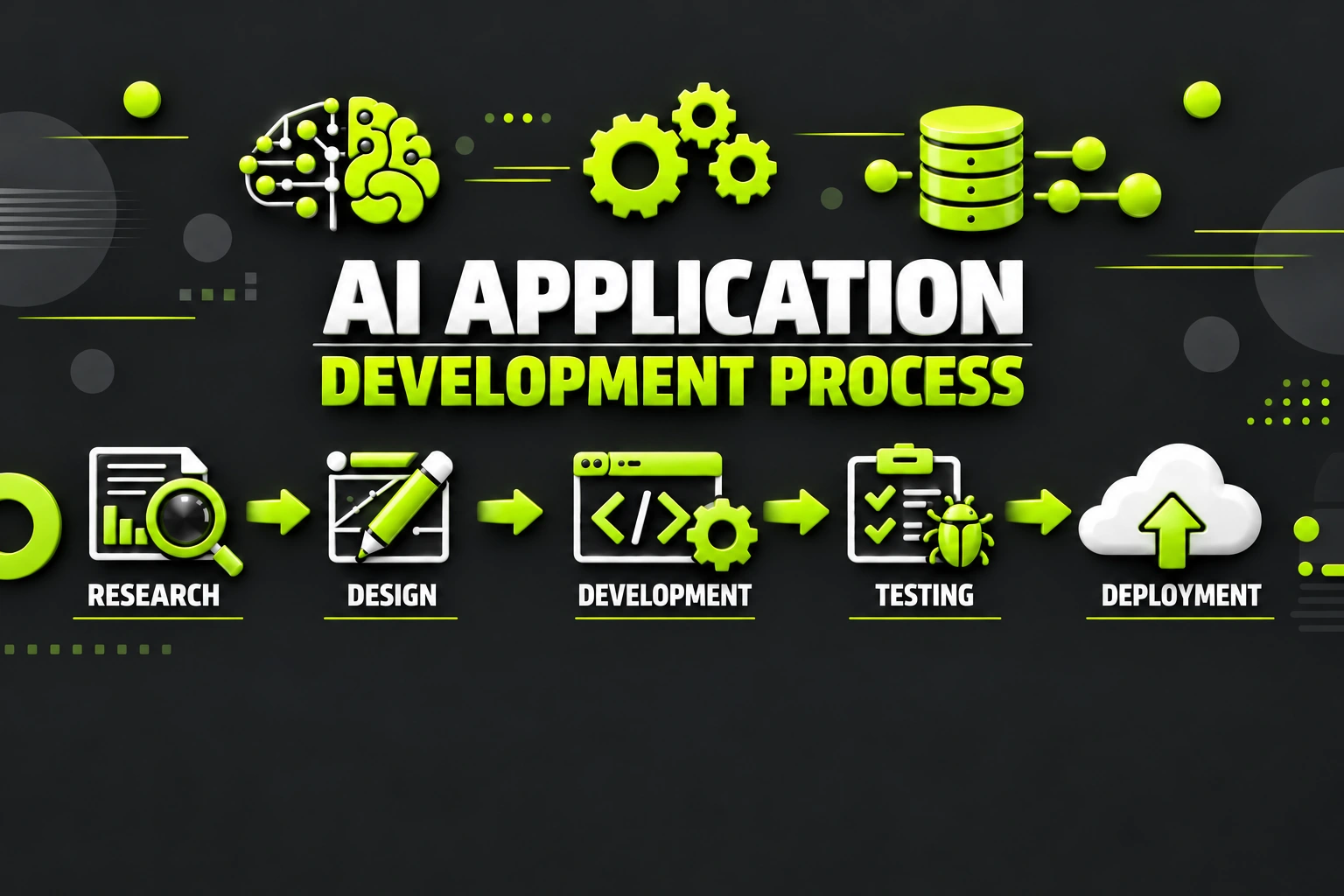
The AI application development process is the translation of a business issue into a working software program with the ability to apply artificial intelligence. It encompasses more than just training models. The team must identify the right use case, collect necessary data, choose the right model, develop the application, incorporate it into business processes, conduct testing, and ensure monitoring afterwards.
Unlike traditional software, an AI application can provide probabilistic output. The performance of an AI application can vary based on changes in user behavior, data, and operating conditions. Thus, the AI application development life cycle needs to encompass software engineering, data handling, model evaluation, security, and improvement.
DigiWeta offers full-fledged AI application development services for companies that need intelligent software tailored to their business processes.
AI App Development Process at a Glance
| Development Stage | Central Question | Primary Output |
| Requirement analysis | What problem should the application solve? | Approved use case, requirements, and success metrics |
| Data preparation | Is suitable, permitted and representative data available? | Governed dataset and repeatable data pipeline |
| Model development | Which model and architecture meet the requirements? | Evaluated model and working application |
| Deployment | Can the application operate securely in production? | Integrated, monitored production release |
| Continuous improvement | Is the application still delivering reliable value? | Monitoring, feedback, and optimization cycle |
While all these steps have a clear order, the process of developing AI does not follow one straight path. The testing phase could uncover missing data, the deployment step could highlight latency issues, and user comments could alter the requirements.
Having a good process enables a team to go back to an earlier decision without losing control of the project.
Requirement Analysis & Feasibility
AI project success begins with a real-life business problem, not a theoretical one. The initial stage of analysis identifies what should be done by the system, who will use it and whether AI is necessary.
The objective “use AI to enhance operations” can’t be considered satisfactory. The requirement must specify how AI will work and what results are expected from the implementation.
A better example of a requirement would be to:
Decrease the time spent by employees on classification and processing of customer documents while keeping the pre-defined level of precision.
It identifies the process, its users, improvement and quality criteria and lays the groundwork for evaluation of the completed application.
Define the Business Problem
The design team will need to map out the current process before designing the future process.
Key considerations include:
- What is the task or decision being improved?
- Who is doing it today?
- How often does it take place?
- What information does the process utilize?
- How much time/money does it take?
- Where are the delays or mistakes taking place?
- What will the AI automate?
- What decisions must be manually approved by humans?
- What outcome is worth it?
This current performance will serve as the baseline. Without it, the organization will have a great app that cannot prove its value added.
Determine Whether AI is Necessary
Not all cases require AI. In fact, there are cases in which a standard business rule, a query in a database, a process workflow, or even a standard software function may work just fine.
Cases where AI is more appropriate would include the need for the application to:
- Identify complex patterns
- Understand natural language
- Perform image/audio/video analysis
- Make predictions based on past data
- Provide customized responses for many different users
- Deal with vast amounts of unstructured data
- Adapt to variation that fixed rules cannot cover
The feasibility assessment should compare AI with simpler alternatives. The aim is to select the most appropriate solution, not the most technically fashionable one.
Evaluate Business, Data, and Technical Feasibility
Even with an attractive use case scenario, an enterprise can fail because of a lack of appropriate data, system integration, ownership, or environment.
The following should be considered:
- Business feasibility: Is the value of the project worth the effort and risk involved?
- Data feasibility: Are there appropriate, representative, and legal data available?
- Technical feasibility: Can the solution be integrated into existing systems?
- Operational feasibility: Will employees adopt the application into their processes?
- Risk feasibility: Can the errors, privacy issues, and negative consequences be managed?
AI risk should be considered throughout the lifecycle. As per the NIST AI Risk Management Framework, risk considerations are categorized into governance, mapping, measurement, and management of AI risks.
Define Success Metrics
Technical metrics on their own cannot guarantee any business benefits. The system can be highly accurate without any improvement to the process where it was used.
The team should collect data on both technical and business metrics.
The technical metrics could be:
- Accuracy, precision, and recall
- False positives and false negatives
- Response relevancy
- Latency
- Availability
- Error rate
- Cost of prediction/processing request
The business metrics could be:
- Time savings per task
- Reduction of mistakes made manually
- Reduced costs of processing
- Faster customer response
- Increased conversion
- Reduced downtime of equipment
- Greater employee adoption
- Higher customer satisfaction
Such metrics should be defined even before development starts, since otherwise the team might use metrics which would present success better than it really is.
Develop a Feasibility Decision
This step should not only result in an executive summary of the meeting but also in a decision package that includes:
- Statement of the approved problem
- Target users and process
- Functionality requirements
- Data sources available
- Integration requirements
- Security and risk management considerations
- Minimum performance level
- Criteria for success
- Scope of proof-of-concept
- Estimated budget and schedule
- Decision to go ahead, revise, or cancel the project
It is recommended that businesses analyze possible issues with producing applications based on AI prior to making a commitment to production.
Data Collection & Preparation
Data is what an AI will learn from, what it uses to retrieve information, and what it will use to generate the output. Low-quality data can adversely affect even a highly sophisticated model.
The data phase should lay a solid foundation for both development and deployment. This phase consists of data discovery, data acquisition, data cleaning, labeling, governance, transformation, and data pipeline creation.
Identify the Needed Data
The initial step in the process involves mapping the data that the application requires.
These could be:
- Operational databases
- CRM and ERP systems
- Business documents
- Customer interactions
- Transaction history
- Product catalogs
- Visual images and videos
- Sensor data
- Events within applications
- Third-party API’s
Even with a significant amount of data, there might still be issues such as missing data, inconsistent definitions, historical bias, duplicate data, and stale data.
Define Data Access and Governance
Data gathering must meet all security, privacy, retention, and compliance standards of the organization.
The development team must define:
- Who owns data source
- Who can access it
- Which fields contain sensitive information
- How consent or permission is managed
- Where the data can be stored
- How long it should be retained
- Whether it can be used for training
- How to audit access and modifications
The sensitive information might require such controls as masking, anonymization, encryption, or a restricted processing environment. All these measures must be put in place before bringing the data into the development process.
Clean and Standardize the Data
Usually, the raw business data is not prepared for use in AI development by default. It might be necessary to:
- Eliminate duplicate entries
- Fix format inconsistencies
- Tackle missing values
- Normalize categories and units
- Handle outliers
- Eliminate unnecessary data
- Standardize terminology
- Fix timestamps
- Consolidate contradicting data sources
All cleaning rules must be described and reproducible. Otherwise, manually corrected data won’t be reproducible later if the model requires new data.
Label & Organize Training Data
Supervised ML models learn from labeled examples. The fraud detection model will require labels for past transactions, where the transaction is either fraud or genuine.
Labels need to be clearly defined. In case the human labelers disagree most of the time, the task itself could be fuzzy.
There should be guidelines for labeling, review process, quality assurance, and resolution process for fuzzy samples.
The prepared dataset is usually divided into training, validation, and test datasets:
- Training data helps the model learn.
- Validation data helps with selecting the right model and settings.
- Test data tests the final performance of the model on previously unseen samples.
The test dataset must not be used before the time of final testing, as otherwise it may lead to an overly optimistic performance estimate.
Design a Reliable Data Pipeline
A production system requires an automated data pipeline process, not an ad hoc spreadsheet export process.
The data pipeline can:
- Gather data from reliable sources.
- Perform data structure and type validation.
- Clean and transform data.
- Apply security and privacy controls.
- Generate features or chunks of documents.
- Store transformed data.
- Produce reliable data for use by the model.
- Measure data quality and pipeline errors.
For generative AI applications, this process includes organizing documents, eliminating old documents, generating searchable chunks, metadata creation, and permission controls. For predictive AI applications, this will include feature generation, label generation, and time-sensitive dataset splits.
This stage must produce:
- Relevant data sources
- Permissions to access data
- Data quality report
- Guidelines for labeling
- Training, validation, and test datasets
- Versioned data transformation logic
- Automated data pipeline
- Data monitoring requirements
AI Model Design & Testing
After data preparation, the project team can choose the AI method and develop the intelligence capability of the application.
It is not about selecting the best technology or model available. The task is to choose the right model and architecture within the constraints of the quality, performance, cost, security, and deployment needs.
Select the Right AI Approach
Various problems call for various techniques:
- A classification model categorizes information into defined classes.
- A regression model forecasts a numeric output.
- A forecasting model predicts future demands or performance.
- Computer vision models evaluate images and videos.
- A natural language processing model interprets or categorizes text.
- Generative models generate or transform information.
- A retrieval-augmented generation model generates replies based on the right information.
- An AI agent orchestrates actions within the system.
For some applications, a customized model is needed. For others, a pre-trained or foundation model, along with business rules, retrieval, prompts, and application logic, will be sufficient.
Starting from a simpler baseline enables teams to understand whether a more sophisticated solution adds enough value to make sense.
Choose the Technology Stack
Python is a common choice for building AI applications since it has features like data processing, experimentation, APIs, and machine learning capabilities.
According to the specific use case, the technology stack can comprise:
- TensorFlow for machine learning and deep learning processes
- PyTorch for building models
- Scikit-learn for traditional machine learning processes
- FastAPI or other frameworks for model APIs
- SQL or NoSQL databases for application data storage
- Vector databases for semantic search
- Tools for experiment tracking to keep track of model and dataset versions
- Cloud technologies for training, serving, and scaling
- Observability platform for application and model monitoring
Technology choice should be based on requirements. Teams need to consider internal skills, data location, data integrations, inference speed, privacy, portability, and costs.
Develop the Model and Application Together
Just having a model is not enough to develop a functional AI product. An application also requires an interface, business logic, authorization, integrations, error handling, and a feedback loop.
The development process must bridge the gap between the model and the workflow of the end user.
For instance, the development of a document-processing application might require the following:
- Accept documents through an application or API
- Check the type and owner of the document
- Identify and categorize information
- Provide confidence and supporting evidence
- Send any doubtful cases for review
- Update the enterprise system
- Log the activity in an audit log
Separate development of a model and an application could lead to integration issues later. Machine learning model integration testing must be performed during development.
Test Predictive AI Systems
The testing of predictive models needs to account for the business implications of different errors.
For instance, a predictive fraud model cannot be evaluated only in terms of its accuracy. The group needs to look at the number of times the system fails to identify fraud cases and delays honest customers.
This can include:
- Accuracy, precision, and recall
- False positives and negatives
- Segmented performance
- Robustness to unusual input
- Latency and throughput
- Explanation capability
- Bias and fairness assessment
- Security and privacy tests
Teams should compare results against the agreed baseline and acceptance criteria.
Test Generative AI Systems
Since generative applications have various correct answers, they need an evaluation process that is different from that of other applications.
The team can evaluate the following aspects:
- Accuracy of the answers
- Relevancy of the answers
- Completeness of the answers
- Reliance on credible sources
- Compliance with instructions
- Quality of citations
- Formatting and tone
- Presence of harmful content or prohibited content
- Resilience to prompt injections
- Accuracy in tool selection
- Response time and cost
A representative evaluation dataset will contain standard requests, hard cases, partial input, conflicting data, and adversarial cases.
Define a Production Readiness Gate
Before release, the application should be able to conform to set standards with respect to the following:
- Model Quality
- Reliability
- Security
- Privacy
- User Experience
- Integration Behavior
- Failure Handling
- Operating Cost
- Documentation
- Human Oversight
If the application cannot meet these criteria, it should be improved before release.
Deployment & Integration
Deployment is when the evaluated application becomes a system accessible to actual users. It involves more than uploading a model to the server.
The development team needs to determine where the application will be run, its integration with the business processes, how it scales, and failure detection and rollback.
Choose Deployment Architecture
It will depend upon the sensitivity of the data, workloads, response time requirements, and available infrastructure.
The choices are as follows:
- Cloud deployment: It will provide you with managed infrastructure and scalability.
- Private cloud or virtual network: This will offer better control over data and connections.
- On-premises deployment: In case there is a special security requirement.
- Edge deployment: It will process the data close to the device/machine.
- Hybrid deployment: Here, the components will be deployed in several different locations.
Cloud platforms will be able to host the model, database, data pipeline, monitoring, and automatic scaling. But the team needs to consider portability, service limitations, data location, security, and operating costs.
Integrate the AI with the Business Systems
The application may need to connect with:
- CRM and ERP systems
- Document management systems
- Website and mobile app
- Customer service systems
- Finance systems
- Data warehouse
- Communication systems
- Manufacturing systems or IoT systems
- Internal APIs
The integration agreement must cover input, output, permissions, error messages, timeouts, and fallback mechanisms.
Structured output is very important when the other system performs actions based on the output of the model. Unstructured text can work well for an end-user AI chatbot, but structured information would be needed for automated processes.
Implement Production Security Controls
Access in production must adhere to the principle of least privilege. User, model, agent, and service access rights should be granted based on the least required permissions.
Some controls could be:
- Authentication
- Authorization by role
- Data encryption
- Secrets management
- Private network access
- Input validation
- Output sanitization
- API rate limits
- Auditing
- Human approval for critical activities
- Incident handling
Security testing should also consider threats unique to AI, including prompt injection, tool hijacking, tampered data sources, and sensitive information leakage.
Release the Application Slowly
This approach will help lower risk and allow you to gather evidence from production.
Deployment methods may include:
- Testing internally
- Testing on small groups
- Shadowing
- Percentage rollout
- A/B testing
- Canary release
- Parallel operation with the current process
Rollback criteria should be established prior to deployment. In case accuracy, latency, costs, or error rates reach certain criteria, the team will have a fallback plan back to a stable version.
Establish Production Observability
Observation must be across the entire application, not just whether the infrastructure is up or down.
The team must observe:
- Request volumes
- Response times
- Application errors
- Model errors
- Pipeline errors
- Quality of predictions or responses
- Cost per token or inference
- User feedback
- Security incidents
- Integrations that fail
- Rate of human escalations
Deployment must end with an operational transfer of ownership.
Maintenance & Continuous Improvement
Deployment of the AI app is not the last stage of developing an AI app. With production use comes new data, new scenarios, and a different environment.
In Google Cloud’s official advice for running machine learning apps, continuous integration, delivery, and training are mentioned.
Monitor Four Types of Performance
A monitoring framework covers four areas:
- Technical Performance: Availability, latency, error rates, throughput, and the overall health of the infrastructure.
- Model Performance: Accuracy, relevance, drift, confidence, and failure modes.
- Business Performance: Time savings, cost savings, adoption rate, conversion rate, or any other approved KPI.
- Risk Performance: Security breaches, undesirable outputs, policy violations, biases, and undesirable actions.
A technically stable system may fail from a business perspective if employees stop using it. Similarly, a widely used system may present undue risk if the outputs are not being monitored.
Detect Data & Model Drift
Data drift refers to changes in the production data relative to the development data. Performance of the models might deteriorate even though the application code is not updated.
The change might be caused by:
- Changing customer behavior
- Seasonality
- Updates in product or policy
- Change in terminology
- Changes in fraudulent behavior
- Change in sensors
- Disruption in the market
- Different users
Teams should define which changes trigger investigation, model adjustment, retraining, or rollback.
Maintain Version Control
The organization should be able to identify which components produced a specific result.
This can include:
- Code for applications
- Models
- Datasets for training
- Logic for data processing
- Prompts
- Data retrieval settings
- Evaluation datasets
- Business rules
- Security policies
The traceability supports debugging, auditability, controlled releases, and incident investigation.
Create a Feedback & Improvement Cycle
User feedback must be gathered in a structured manner. Positive or negative ratings alone don’t say much about the problem.
More valuable feedback could indicate that the result was:
- Incorrect
- Incomplete
- Irrelevant
- Outdated
- Improperly formatted
- Based on the wrong source
- Lacking appropriate context
- Sent through the wrong pipeline
Teams can use this evidence to improve data, prompts, models, and user experience, or business rules.
Manage Performance & Cost
The more powerful model will not necessarily build a better business app. It could just raise latency and operating cost without delivering any improvement.
Ongoing enhancements could include:
- Routing easy tasks to simpler models
- Caching acceptable responses
- Removing unnecessary context
- Improving retrieval
- Optimizing data queries
- Batching suitable workloads
- Removing unused functionality
- Reviewing third-party services’ costs
Maintenance priorities should follow evidence from production rather than assumptions made during development.
FAQs
What is the AI application development process?
It refers to the lifecycle that is involved in planning, designing, deployment, and maintenance of the AI-enabled application. It includes business needs, data preparation, modeling, application development, evaluation, system integration, security, deployment, monitoring, and improvements.
How does the AI development process differ from the traditional software development process?
The traditional software development process usually adheres to a set of rules, and the output can be predicted. However, in the case of AI applications, learning is done based on data and therefore, developers must take care of many other things, including data quality, model evaluations, drift, responsible AI challenges, and production behavior.
What are the key phases of the AI application development process?
There are five major phases – requirement analysis and feasibility, data acquisition and preparation, model development and testing, deployment and integration, and maintenance and improvements.
Is custom model training necessary for every AI application?
No. The most common use of existing machine learning or foundation models with additional data from the company, retrieval, prompts, business rules, and application logic is a common practice.
The need for custom training arises when the existing models cannot satisfy the needs of the project in terms of accuracy, domain, privacy, or other specific demands.
How much data do we need for building an AI application?
It depends on the use case, the model approach, complexity, and other aspects. Often, the quality, relevance, proper representation, and labeling of the data are more important than just the volume.
Feasibility assessment helps to understand whether the available data are enough for building the application.
What technologies are used in the AI application development?
Common technologies include Python, TensorFlow, PyTorch, machine learning libraries, application APIs, databases, vector stores, container platforms, and others.
How long does AI application development take?
The process depends on various factors such as scope, data readiness, integrations, models needed, compliance, and production considerations. A proof-of-concept implementation takes less time than an enterprise application running across multiple systems.
How is an AI model tested before deployment?
Tests can be carried out on accuracy, relevance, false positives, false negatives, latency, robustness, security, fairness, cost, and performance.
Generative AI models need tests for grounding, factual correctness, instruction-following, unsafe responses, and resistance to prompt injection.
Why do AI applications require continuous maintenance?
AI applications run in an environment that may evolve as far as data from the business, user behaviors, languages used, policies, and model suppliers are concerned. Maintenance will help the team identify problems in terms of decreasing performance, security, drift, integration, and increasing operational costs.
Who should participate in the development process?
The team might consist of business owners, users, product managers, AI engineers, data engineers, software developers, designers, security experts, regulatory representatives, and quality assurance staff.
Ownership is critical since a technical team on its own can’t specify the right business outcome or risk level.
Move from AI Idea to Production with DigiWeta
Building a reliable AI solution doesn’t mean developing a model and integrating it with the interface. DigiWeta supports you in managing the entire project lifecycle. Our team combines AI consulting, data engineering, model engineering, application engineering, integration, deployment, and optimization.