

Enterprise automation works best when its design matches the task. Fixed rules can handle predictable steps, while AI may help interpret information or choose between permitted actions. Before adding an agent, identify the limits of the current workflow and compare whether a simpler change could solve the problem with less cost or risk.
Agentic AI describes systems that use models to select steps or tools toward a goal. Their autonomy depends on the permissions, environment, and review controls provided. They should not be treated as unrestricted operators or assumed to improve themselves automatically.
The useful distinction is whether a workflow follows fixed steps or selects steps. Both approaches need defined responsibilities, reliable inputs, and tested failure handling. More autonomy is not automatically a better fit for an enterprise task.
Define Agent Roles
An agent may plan and use tools within an assigned scope. Evaluate the actual capabilities and controls rather than relying on the label. Depending on the implementation, it may:
- Interpret a defined objective
- Plan steps toward a goal
- Compare available options
- Use permitted tools and interfaces
- Use recorded results as context
Agents may adapt steps to information, but can misunderstand goals or evidence. Define permitted access, actions, approvals, and stopping conditions. Test those boundaries instead of assuming flexibility guarantees correct results.
Use agents where bounded flexibility has a demonstrated benefit, not as a replacement for clear process ownership.
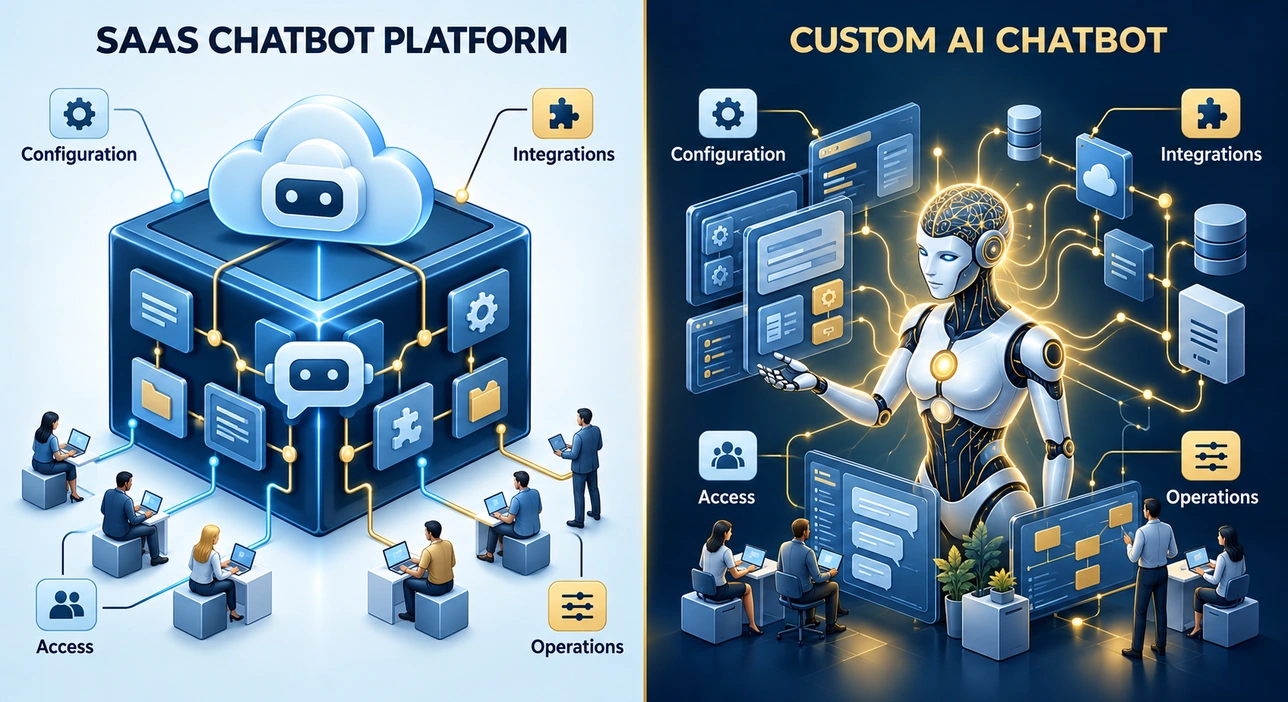
Compare Fixed and Agentic Workflows
These approaches can coexist. Choose according to the decisions and controls the task requires:
- Defined Workflows: Set steps with tested exception paths
- AI Assistance: Model output within reviewed processes
- Agentic Workflows: Tool selection within granted boundaries
Fixed automation can be reliable for known steps. Agents may help when selecting the next step requires interpretation, but add uncertainty and oversight needs. Compare both on the same task, including errors, cost, and recovery.
Design the Agent Workflow
The implementation should make objectives, permissions, state, and outcome checks explicit:
1. Define Goals and Limits
Describe the intended result, available information, permitted operations, and stopping conditions. Broad goals such as maintaining uptime should not grant open-ended authority to change production systems.
2. Check Proposed Actions
Check details, permissions, and approvals before execution. A model’s plan does not prove an action is safe or authorized.
3. Control Retained Context
Decide what history or state the agent needs, where it is stored, and who may access it. Retention does not automatically produce learning or improvement. Test outdated assumptions, account changes, and deletion. For information retrieval, review secure knowledge access for enterprises as part of the workflow’s data and permission design.
4. Limit Tool Capabilities
Connect only the interfaces needed for the task. Validate inputs, protect credentials, and handle failures or uncertain outcomes before retrying.
5. Evaluate and Improve
Improve through reviewed outcomes and controlled updates, not assumed automatic learning.
Together, these controls make the agent’s work inspectable and keep responsibility with the organization.
Compare Controls as Well as Capabilities
| Aspect | Fixed Workflows | Agentic Workflows |
| Flow | Rule-led | Goal-led |
| Scope | Set | Set |
| Exceptions | Policy | Policy |
| Capacity | Tested | Tested |
| Updates | Planned | Planned |
| Change | Scoped | Scoped |
The table highlights shared responsibilities: scope, exception policy, capacity testing, and controlled updates. An agent’s flexible planning does not remove those requirements.
Possible Enterprise Agent Workflows
The following examples describe possible roles to evaluate, not guaranteed deployments or results:
Customer Service Assistance
An agent may retrieve approved information or prepare a supported request. Preserve access checks, action confirmation, and a route to staff. Measure successful resolution rather than assuming automation improves every interaction.
IT Operations Assistance
Agents may summarize alerts or propose diagnostics. Bound execution and review changes rather than assuming incidents will be prevented.
Finance and Review Assistance
Prepare records or drafts for reviewers. Keep consequential decisions, approvals, and compliance judgments in governed processes.
Supply and Operations Support
Assemble data or propose steps. Review consequential inventory, purchasing, and supplier commitments under agreed controls.
Retain accountable owners and bounded actions rather than handing entire workflows to an unchecked model.
Measure Potential Business Benefits
Define a baseline and test whether the agent improves outcomes such as:
- Shorter task completion
- Less avoidable manual effort
- Clearer failure recovery
- Manageable workload handling
- Evidence-led process updates
- More focused staff time
Measure review effort and rework as well as speed. Assistance may shift tasks, but skilled people and ownership remain necessary.
Preserve Human Review and Control
Define the controls needed for the use case, including:
- Approval for consequential actions
- Traceable inputs, decisions, and results
- Verified identity and limited permissions
- Monitoring and incident procedures
Test controls in practice. A checklist alone does not establish safety, compliance, or alignment with business requirements.
Identify Delivery and Operating Challenges
Assess practical constraints before expanding scope:
- Source quality and system access
- Legacy interface limits
- Uncertain outputs and evidence
- Team adoption needs
- Review and ownership requirements
Plan how each constraint will be tested, owned, and managed after launch.
Start with a Bounded Pilot
Select a repeatable workflow with a clear owner, useful baseline, and manageable risk. Define the outcome, permitted data, tool scope, and escalation route. Test representative cases and exceptions before extending access or relying on the agent for consequential work.
Use the results to compare agentic and simpler approaches. If you need delivery support, discuss the workflow with DigiWeta and agree a testable scope and operating responsibilities.
DigiWeta can discuss agent requirements around your existing systems and controls. Plan integration, evaluation, handover, and ongoing review together rather than assuming the first demonstration establishes readiness for wider deployment.
Expand Only When Evidence Supports It
Agentic AI is one way to organize software workflows, not a universal replacement for rules or people. Use observed task quality, cost, and failure behavior to decide where it fits. Keep permissions narrow and review changes so added autonomy remains tied to an explicit purpose.
Frequently Asked Questions
It generally describes systems where a model selects steps or tools toward a goal. Capabilities depend on the implementation and granted permissions. Define scope, approvals, and stopping conditions, and evaluate outcomes. An agent label does not imply reliable judgment, unrestricted authority, or automatic improvement.
A fixed workflow follows predefined steps; an agent may choose the next step using context. Both can include AI and both need controls. Compare task quality, predictability, cost, and recovery rather than assuming flexible planning is always better.
Assess the intended task, data, tools, permissions, oversight, and failure handling. Test representative and adversarial cases before expanding scope. Approval checkpoints and logs help only when implemented effectively; no control set guarantees every agent action is safe.
Possible tasks include assembling support context, summarizing alerts, preparing documents, or coordinating permitted steps. Select clear inputs, measurable outcomes, and accountable owners. Keep consequential decisions and commitments under appropriate review.
Not necessarily. They may change task allocation, but people still own requirements, review, exceptions, and operation. Measure the full workflow, including rework and oversight, instead of assuming automation replaces roles or guarantees productivity gains.