
It is not necessary for a hospital to use the same AI application to determine high-risk patients as a retail store utilizes to predict product demand. The best use cases for AI applications start from the problem itself that needs improvement, a decision and good data.
AI can analyze complex data, finding patterns, making predictions, personalizing experiences and automating tasks. Yet, the true power of this technology comes out once it is used daily by an organization.
At DigiWeta, we help companies find, design and implement effective AI applications. Our AI application development services involve connecting intelligent algorithms to the processes and data already used by the company.
Where are AI Applications Creating Business Value?
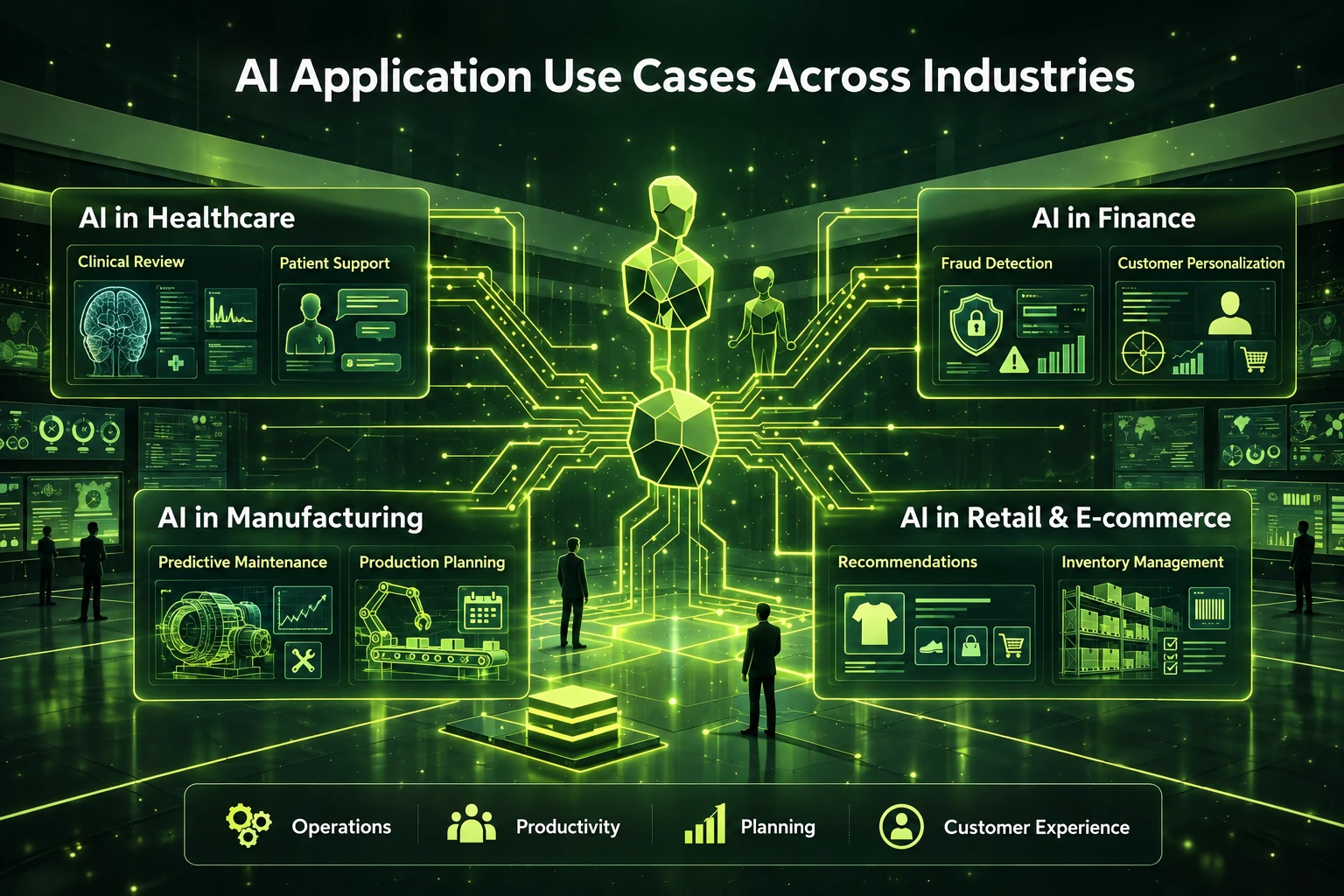
The applications of artificial intelligence add value differently in different industries. For instance, health care institutions are using it to enhance workflow within the industry. Financial companies utilize artificial intelligence in risk management, fraud detection, and customer engagement. Retailers leverage AI in predicting demand and enhancing the shopping experience. Manufacturers leverage AI to detect equipment problems and improve production planning.
| Industry | Common AI Applications | Primary Business Value |
| Healthcare | Predictive analysis, patient support, document processing | Quick insights and efficient care operations |
| Finance | Fraud detection, risk analysis, personalization | Reduced risk and improved customer engagement |
| Retail | Recommendations, demand forecasting, inventory planning | Higher relevance and better stock management |
| Manufacturing | Predictive maintenance, visual inspection, supply chain planning | Less downtime and stronger operational efficiency |
The good opportunity is not always the most technically advanced application. It is usually the one connected to a costly delay, repeated decision, customer issue, or inefficient workflow.
AI in Healthcare
The health care industry deals with vast amounts of clinical documentation, diagnostic imaging, patient correspondence, claims, scheduling, and operations data. Manual review of such information may delay decision-making and place an excessive burden on healthcare professionals.
Healthcare AI can help manage complicated information, spot patterns, and provide professionals with relevant insights promptly. Moreover, it can automate tedious administrative processes that detract from patient care.
Nonetheless, the applications of AI for healthcare need to be adequately protected, evaluated, and overseen by people.
Diagnostics & Predictive Analysis
AI can aid healthcare professionals in analyzing the medical information and identifying patterns related to risks or anomalies. The system can monitor various information depending on the application, such as clinical data, laboratory results, medical imaging, medical history, and monitoring information.
Some applications that can be useful include:
- Identifying patients requiring additional examination
- Recognizing unusual patterns in medical images
- Predicting the risk of readmission or deterioration
- Triage assistance
- Analysis of laboratory result trends
- Forecasting demand for beds, personnel, and other medical resources
- Identification of missing or contradictory clinical information
For instance, a predictive application can analyze several factors and prioritize some cases for review. In this case, the application will not provide the final diagnosis, but it will assist healthcare professionals in focusing on some cases for faster examination.
In addition, applications in medical imaging field can assist radiologists in identifying possible problems. Healthcare professionals will be able to consider the results in context of the clinical information.
To be effective, the organization should measure not only model accuracy, but also false positives, missed findings, data quality, patient population performance, and the impact of the erroneous recommendation.
Patient Care Automation
There are many repetitive administrative processes involved in patient care. This includes scheduling appointments, sending reminders, collecting information, preparing documents, answering routine questions, and arranging for follow-ups.
These activities may be handled by automation based on AI technology and will give healthcare professionals enough time for patient care.
Some examples are:
- Intelligent appointment scheduling
- Appointment and medication reminders
- Patient intake assistance
- Assistance in answering frequently asked questions
- Medical document summarization
- Following up with patients
- Handling insurance and claims documents
- Analyzing patient feedback
- Coordination alerts
For instance, a patient support assistant may answer pre-approved questions on appointments, procedures, preparation guidelines, and administrative issues. It will also detect when an inquiry requires a healthcare professional and pass it along.
Natural language processing may be used to summarize long documents or conversations. But medical information contained in such documents needs to be verified by authorized staff members prior to being used for clinical decisions.
The best patient care automation systems set out clear limits. This includes setting the scope of questions answered, situations requiring escalation, access to data and actions requiring approval.
AI in Finance
Organizations in the finance sector deal with a steady stream of transactions, applications, customer engagement, market data, and regulatory information. These factors create an environment where manual interpretation becomes tough.
Finance AI can discover anomalies, recognize risks, automate tedious processes, and provide better experiences for customers. It can assist banks, financial technology firms, insurance companies, lenders, and investment portals in making faster and uniform decisions.
Due to the fact that financial decisions may have a major impact on customers, such applications require explainability, security, and monitoring.
Fraud Detection
Traditional fraud detection methods employ predetermined rules. For instance, a transaction exceeding a certain limit or coming from an unfamiliar place can trigger the rule.
The rules are still valuable, but fraud is constantly changing. Machine learning algorithms can supplement them in detecting relationships and behavioral patterns in many transactions.
An artificial intelligence-based fraud detection method could include analysis of:
- Transaction size and frequency
- Purchasing patterns of a client
- Activity on devices and in accounts
- Patterns of logins
- Geographical inconsistencies
- Characteristics of merchants
- Relationships between accounts
- Historical indicators of fraud
The method can assign risk scores and forward suspicious activities to investigation. It allows prioritizing risky cases for investigation instead of looking at every transaction.
A good fraud detection approach should be balanced. A detection method that misses fraud exposes the company to risks. On the other hand, a method that produces too many suspicious transactions annoys the clients and generates extra expenses for investigation.
Thus, financial institutions must track false positives, fraud, model drift, and transaction changes.
Customer Personalization
Financial customers are characterized by different goals, behavior patterns, requirements in terms of services, and financial literacy levels. The use of generic messages may hide crucial information and decrease the interaction level.
AI can be used in the context of providing personalized experience for customers based on their context and predefined business rules.
Possible use cases can include:
- Personalized financial education
- Smart customer-support routing
- Tailored service recommendations
- Personalized onboarding processes
- Insights into spending and budgeting patterns
- Next-best-action recommendations
- Prediction of customer churn
- Personalized alerts and notifications
For instance, an application in the banking industry can analyze customer spending patterns and provide them with insights about their spending every month. An intelligent support platform can analyze the reason for a customer support request and forward it to the appropriate specialist.
Customer personalization is supposed to be transparent and responsible. The use of confidential information inappropriately should be prevented and recommendations should be reviewed regularly to avoid any unfair treatment.
The goal here is not to force customers into buying unnecessary products. It is to make financial services more relevant, accessible, and responsive.
AI in Retail & E-commerce
The decisions that retailers must take on products, prices, inventory, marketing, suppliers, and customer experience get increasingly complex as their range of products and sales channels grow.
AI in retail allows companies to perform analysis of customer behavior and company-related data on a large scale. There are a number of uses of retail AI that could help with product discovery, forecasting demand, personalization, and inventory issues.
For the consumer, it translates into a more convenient shopping process. For the retailer, it leads to better control over inventory and business-related decision-making.
Recommendation Engines
Recommendation engines are used to provide customers with suggestions for products according to their interests, needs, or current browsing context. The engines can use browsing history, purchase history, product features, searching behavior, and even similarity between customers.
Examples of recommendation engine usage include:
- “Recommended for you” product collections
- Product suggestions purchased together
- Suggested complementary products
- Personalized homepage
- Relevant search results
- Alternative product suggestions
- Replenishment recommendations
- Personalized emails and app content
Not only can browsing history be considered in order to find out customer interests, but also the availability of the product, seasonality, product price range, and customer preferences.
For instance, suggesting an unavailable product can be seen as a relevant recommendation but will not give a good user experience. The integration of a recommendation engine with live inventory data will make it much more commercially valuable.
The quality of recommendation engines should be measured through such metrics as engagement, conversions, basket size, customer satisfaction, and product diversification.
Inventory management
In making inventory decisions, retailers must strike a balance between ensuring that their products are available on hand and avoiding excessive stock levels that could be expensive to hold.
AI solutions can leverage sales history and other factors that provide demand signals and result in better predictions.
Some demand signals can include the following:
- Seasonal shopping trends
- Marketing and promotions
- Pricing of products
- Store or region performance
- Supplier lead times
- Returns and cancellations
- Customer search behavior online
- Demand-related external factors
- Product lifecycle factors
The intelligent inventory management system can generate demand forecasts at different levels, including product, category, store, or region. This tool can assist in making plans around replenishments, transfers, procurement, and promotions.
AI can also detect slow-moving stock, abnormal demand changes, and potential out-of-stock situations. This will provide the merchandising and supply chain teams enough time to act.
Predictions should inform commercial decisions and not function without checks. Buyers and inventory managers might have additional information that would not be reflected in the historical data.
AI in Manufacturing
In manufacturing companies, reliability of machines, quality of products, production planning, and coordination in the supply chain matter the most. Anything wrong in any of these aspects can hamper output, schedules, and commitments to customers.
Enterprise AI solutions can use sensor data, maintenance data, production data, quality images, supplier performance data, and inventory data. They can be used by teams for early problem identification and making sound decisions.
Enterprise AI automation becomes particularly useful when it links shop floor data with planning, maintenance, purchasing, and management.
Predictive Maintenance
Traditional maintenance often follows one of two methods. Machines undergo planned maintenance based on a set schedule, or repair begins once the machine breaks down.
Both methods may cause unnecessary expenses. The former might replace parts that have remaining useful life, while the latter may result in unexpected stoppage.
Predictive maintenance analyzes data on the machine to spot patterns indicative of wear, degradation, or potential machine failure.
The system could assess:
- Temperature
- Pressure
- Vibration
- Energy usage
- Machine speed
- Logs of errors
- Past maintenance
- Part life
- Production conditions
If the system spots any unusual patterns, it would notify the maintenance personnel and offer relevant supporting data. The personnel could examine the machine to see whether any action needs to be taken.
Predictive maintenance would help organizations perform maintenance on schedule and improve availability of spare parts.
Supply Chain Optimization
A manufacturing supply chain includes suppliers, raw materials, production capacity, inventory, warehouses, transportation, and customer demand. Delays in any of these areas have implications for the entire production process.
An AI system can aggregate the data to help manufacturers forecast problems and evaluate their options.
Applications in the supply chain include:
- Demand forecasting
- Planning for raw materials
- Supplier performance analysis
- Production scheduling
- Inventory optimization
- Logistics planning
- Lead time forecasting
- Disruption detection
- Scenario analysis
For example, an AI system could determine that a delay in a material will be a problem in future orders. It could then display to planners which production lines are affected, inventory on hand, alternate suppliers, and scheduling options.
AI doesn’t solve the problem of uncertain supply chains; it enables teams to see potential problems sooner and evaluate options.
The best systems are those that tie into existing ERP, warehouse, procurement, and production systems. This way, the recommendations can factor in real-time conditions rather than disconnected historical reporting.
How to Select the Right AI Use Case?
There may be many options for AI use cases, making prioritization difficult. Companies may be inclined to go after the most visually or technologically attractive option.
A better way would be to consider the opportunity in relation to its business value, feasibility, risk, and data availability.
Before proceeding, ask yourself:
- Does the use case solve an important business problem?
- How frequent is the process?
- How much does the existing process cost?
- Are there any data available?
- Can the results be measured?
- What is the effect of error?
- Will any human intervention be necessary?
- Which systems must be integrated?
- Can the solution be scaled past the pilot?
The ideal AI application has an operational owner, a measurable baseline, and is defined sufficiently small that it can be tested in a realistic business environment.
Companies can start by working on a proof of concept if technical feasibility is still in doubt. After proving the assumptions behind the solution, the application can go through a process of development for use in a real-world scenario.
Organizations with specific data needs or workflow needs might want to develop custom applications for AI instead of off-the-shelf solutions.
AI Application Use Cases FAQs
What are some common AI application use cases?
Some common AI applications include customer service automation, fraud detection, product recommendations, demand prediction, document processing, predictive maintenance, quality control, and enterprise knowledge assistants. The use case that will work the best is determined by the company’s unique needs.
What industries get the most value out of AI applications?
Industries like healthcare, finance, retail, manufacturing, logistics, professional services, and technology organizations can all see value in AI applications.
The value doesn’t stem from being labeled one type of industry but rather from finding an opportunity to repeat a process or make a decision that could benefit from AI.
How does enterprise AI differ from consumer AI?
In general, consumer AI works to help individuals. In contrast, enterprise AI operates in business environments, uses controlled company data, allows permission settings, is integrated into workflows, and must satisfy strict security and reliability requirements.
Which business processes can AI automate?
AI can help in such processes as document intake, classification, data extraction, request routing, reporting, knowledge base lookup, forecasting, transaction monitoring, and workflow prioritization.
Business automation is most successful where the process has identifiable inputs, repeatable operations, exceptions, and results.
Does a business need large amounts of data to use AI?
Large custom training datasets may not be necessary for all AI solutions. There are solutions that leverage existing models plus company documents, databases, APIs, and business logic.
Predictive and industry-specific machine learning models need enough historical data representative of the decision or event to predict.
How should a company measure the value of an AI application?
A firm should compare the application to a measurable benchmark. Examples of possible metrics include processing speed, accuracy, cost of operation, forecast accuracy, machine downtime, customer satisfaction, conversion rate, or employee productivity.
The metric chosen needs to be relevant to the business problem that the application aims to solve.
What are some common risks of implementing AI?
Some typical risks include poor data quality, inaccurate results, privacy concerns, security risks, biased decision-making, poor integration, lack of control over usage costs, and limited adoption by employees.
Firms can minimize the above risks through testing, controls, monitoring, reviews, and clear application boundaries.
Should AI applications replace human decision-making?
AI should assist in decision-making depending on the level of risk and complexity involved. For instance, low-risk and repetitive decisions can have more automation than other decisions in sectors like health care, finance, employment, or law.
The application should outline its boundaries.
Transform Your Best AI Use Case into a Practical Solution
Your company benefits from AI when you leverage it to enhance a practical process, make decisions, or deliver an exceptional customer experience.
DigiWeta supports companies in identifying and assessing the best use cases for their AI applications and helps convert the most beneficial use cases into secure, scalable software solutions.