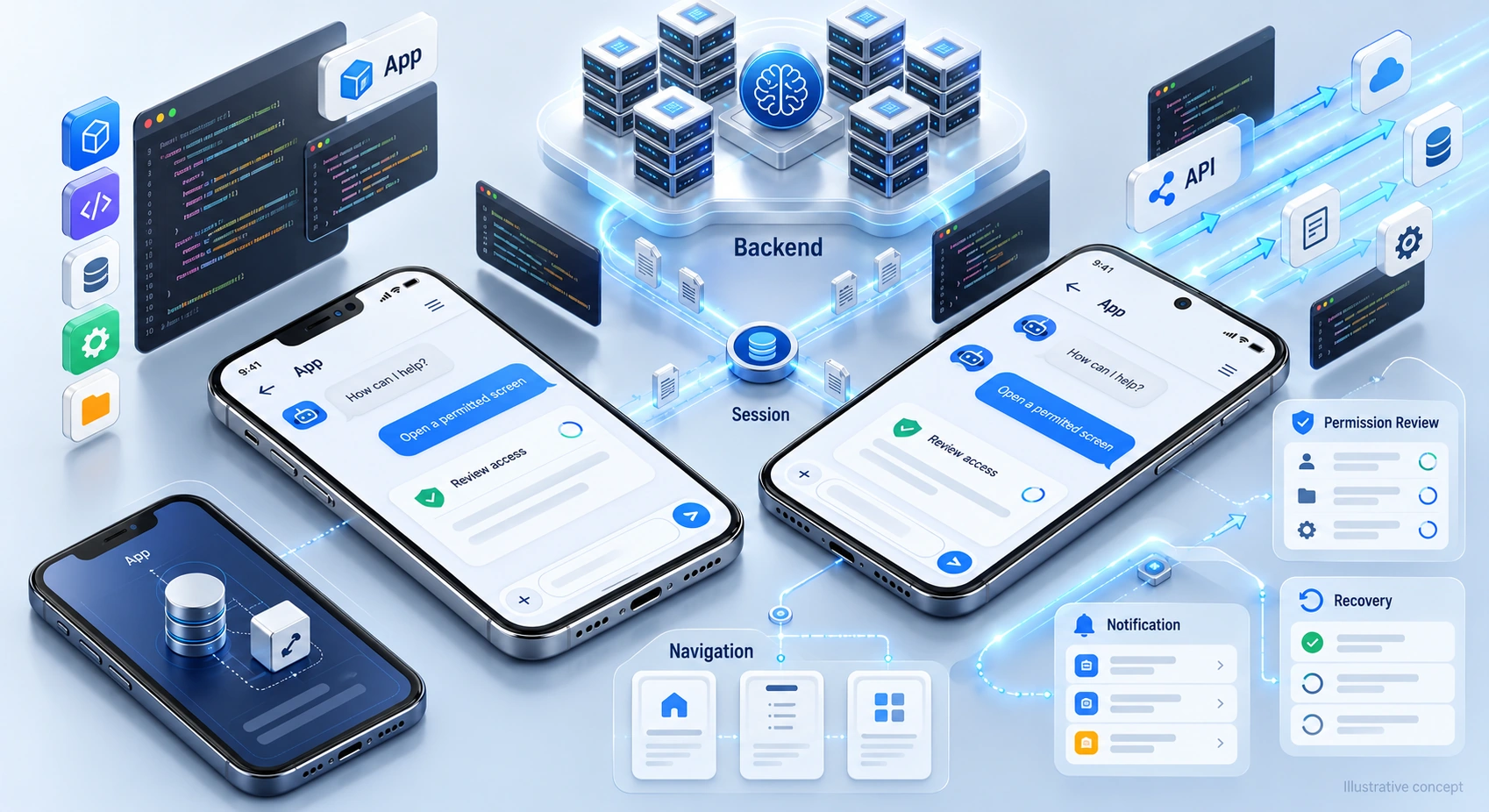


A working prototype does not show how an AI feature will behave under production demand. Evaluate real requests, concurrency, permissions, failures, and operating costs before choosing capacity or infrastructure. The goal is an architecture matched to the service, not a collection of components added because they appear in other AI systems.
Plan for provider limits, changing latency, request size, and usage costs. Test how the application behaves when a dependency slows down or fails.
Production generative ai application development combines model behavior with familiar engineering responsibilities: identity, access, state, integration, monitoring, and recovery. Set measurable service targets, then test the proposed design against them instead of promising unlimited scale or instant responses.
This guide explains the decisions behind a maintainable LLM application: request control, orchestration, context, background work, and tenant isolation. For the broader process, review our guide to building generative ai software. If additional delivery support is needed, discuss the scope of DigiWeta’s enterprise generative ai development services around your workload, systems, and operating needs.
Chapter 1: Define Service Boundaries and Targets
Start with the customer journey and its required data and actions. Specify what a successful request means, acceptable waiting behavior, and how errors should be reported.
Model calls can vary in duration, cost, and output. Keep those uncertainties from undermining the surrounding service. Decide where validation, timeouts, limits, and recovery belong, and measure behavior with representative workloads rather than assuming every AI backend needs the same middleware.
Control Requests and Credentials
Do not embed long-lived server secrets in browser code. Use an appropriate backend or supported credential design to enforce access and usage controls.
A gateway can centralize some controls, but a dedicated product is not mandatory for every application. Assign clear ownership for identity, tenant access, quotas, observability, and provider routing, wherever those functions are implemented:
- Tenant Access Controls: Verify the user and tenant in trusted logic. Enforce permissions across requests, retrieval, history, caches, and outputs; a gateway alone does not establish isolation.
- Usage Limits: Set limits appropriate to tenant demand and provider capacity. Define queueing, rejection, and retry behavior so one workload cannot consume all available resources. Test peaks instead of relying on average traffic.
- Safe Caching: Reuse answers only when they remain valid for the user, permissions, source version, and task. Similar wording can refer to different records or policies. Define expiry and invalidation, and measure quality as well as saved usage.
Plan Failure and Fallback Behavior
Decide what users see during an outage or slow response. Some tasks can wait or degrade gracefully; others should stop. Fallbacks must preserve data and quality requirements rather than simply send requests elsewhere.
Fallback routing is optional and needs the same controls as the primary route.
- Design Check: Before switching providers or models, verify permitted data handling, feature compatibility, quality, and cost. Test timeouts, rate limits, and retry bounds. Avoid duplicating actions when a prior result is uncertain.
- Redundancy can improve resilience, but it does not guarantee a particular uptime. Set and measure service targets for the complete application.
Chapter 2: Make Workflow State and Ownership Clear
Orchestration coordinates the required steps, state, and errors. Keep business rules and permissions in controlled application logic rather than assuming the model will reliably enforce them.
Frameworks may help, but direct code can also manage workflows. Choose an approach based on maintainability, testing, and the capabilities needed. No library name proves that state, memory, or tools are handled correctly.
Choose Fixed Workflows or Bounded Agents
For ticket summaries, define permitted records, output requirements, and the intended recipient. Retrieval, drafting, and sending are separate actions; each needs appropriate permissions and review.
Use framework components where they simplify a tested workflow.
- Expose only tools needed for the task, with clear input validation, access limits, and approval requirements.
- If the model selects a tool, trusted code should still validate the action and handle its result. Define stopping conditions and failure recovery.
- Modular interfaces can make model changes easier, but replacements still need testing for quality, compatibility, cost, and safety. Do not assume a provider change is behaviorally neutral.
Manage Source Updates and Retrieval
Data tools can support ingestion and retrieval, but source lifecycle and permissions still need explicit design and ownership.
Plan updates, deletions, permission changes, and failed indexing. Check how quickly changes become available and how stale results are detected. The chosen framework does not guarantee immediate synchronization. For the distinction between source context and model adaptation, compare RAG vs Fine-Tuning architectures.
Chapter 3: Select Relevant Context
Context management affects quality, privacy, latency, and cost. Define what each request actually needs.
Context capacity is not a reason to send every record. Measure representative requests. Include task instructions, relevant evidence, and needed conversation state while avoiding unnecessary private data. Evaluate context selection instead of relying on one universal length rule.
- Usage Costs: Larger requests may increase billed usage or processing time. Apply current service rates and measure representative workloads, including retries and background work.
- Answer Quality: More context is not always better. Relevant information may be hard to use when sources conflict or instructions are buried. Test the actual model and document patterns rather than assuming every long request behaves the same way.
Review Conversation State
Keep context selection and retained state deliberate and testable.
- Conversation Summaries: Summaries may reduce repeated context but can omit or distort details. Preserve critical verified fields and test updates, corrections, and changes in user requirements.
- Useful Retrieval: Select permitted material that supports the current question. Check relevance and freshness, and clarify when the available evidence is insufficient.
- Compare context strategies against quality and cost targets. Smaller requests can help some workloads, but do not guarantee accuracy or sub-second responses.
Chapter 4: Handle Long Tasks Responsively
Estimate the duration and resource use of each task. Short operations may fit a direct response, while longer jobs may benefit from background processing. Choose based on workload and service needs, not a fixed assumption that every database call is fast or every model request requires the same delay.
Test concurrency, connection limits, cancellation, and recovery. The surrounding service should not become unresponsive simply because a model call is pending. Bound work and communicate status clearly.
Use Queues Where They Fit
Choose asynchronous processing when it suits the task.
- For a background job, acknowledge acceptance and provide a way to track status. Acceptance is not completion; show queued, running, failed, or completed states accurately.
- Place work in an appropriate queue and define capacity, retries, expiry, and cancellation behavior.
- Workers process permitted jobs and record their outcomes. Ensure retries do not duplicate consequential actions, and handle partial or uncertain results. Deliver updates through a suitable interface, with access checks when the user retrieves them.
Background work can improve responsiveness but needs monitoring, recovery, and capacity tests. It does not guarantee stability.
Chapter 5: Test Tenant and Data Boundaries
In multi-tenant SaaS, isolation needs to cover source access, retrieval, history, caches, logs, and outputs. Test both ordinary and adversarial requests across tenants, including permission changes. Do not rely only on a tenant identifier mentioned in a prompt.
Enforce Retrieval Access
Use verified identity and source permissions to restrict retrieval in trusted backend logic. Namespace separation, metadata filtering, or other designs may fit, but each must be tested. Include ingestion, updates, deletion, and cache behavior so stale permissions do not expose records after access changes.
Hosting Review
Assess the chosen service, settings, agreements, and data recipients against your requirements. A private cloud is not automatically isolated, and external APIs do not all have the same terms. Compare actual controls and operating responsibilities rather than assuming one hosting category guarantees compliance.
Use qualified review and appropriate testing when planning preventing proprietary data leaks within the intended application.
Chapter 6: Context and Answer Quality
A conversational interface needs clear scope, state handling, and escalation. Decide what users can do, what information is retained, and how they can correct an assumption or reach a person.
Choose a state store that fits the access, retention, consistency, and recovery requirements. SQL, document stores, or other approaches may be suitable. No single database type is mandatory simply because the application uses a language model.
Test answers against approved evidence and define behavior for uncertainty, unavailable records, and failed actions. Output checks are useful only with understood limits. For related evaluation practices, see reducing chatbot hallucinations. No safeguard guarantees that every generated answer is correct.
Scope Your AI Backend with DigiWeta
Begin with a workload, service targets, and explicit data boundaries. These define the necessary infrastructure and review work more clearly than a preferred framework or an assumed scaling pattern.
Discuss enterprise generative ai development services with DigiWeta around your SaaS workflows and existing systems. Agree the initial architecture, evaluation criteria, failure handling, and operating ownership. Measure changes before expanding capacity or promising service levels.
Ready to review your backend requirements? Contact DigiWeta to discuss scope, workload, and a practical delivery plan.
Frequently Asked Questions
It connects models to users, data, and permitted workflows through appropriate access controls, state, monitoring, and recovery. Gateways, queues, retrieval stores, and frameworks may help, but required components depend on the application rather than a universal checklist.
Keep server secrets out of browser code and use an appropriate backend or supported credential mechanism. Enforce identity, permissions, and usage limits in trusted logic. Review the actual client and service design rather than assuming every application needs one particular gateway product.
It can help coordinate models, tools, state, and workflow steps. Direct application code may also fit. Evaluate maintainability, testing, permissions, and failure handling; using a framework does not automatically make the system scalable or reliable.
Measure representative requests and apply current rates. Review context size, retries, background work, model choice, and safe caching. Test optimizations against quality and privacy, set appropriate limits, and monitor actual spending rather than assuming one technique always reduces cost.
Match storage to business records, conversation state, search, or audit needs. Compare access, consistency, updates, workload, and maintenance. Retrieval may use vector, keyword, or hybrid methods; not every application needs a standalone vector database.
Use background processing where task duration and service needs justify it. Define queue limits, status, cancellation, retry safety, and result access. Short tasks may use a direct response. Streaming can improve feedback but does not remove processing time or the need for error handling.
Verify permissions across ingestion, retrieval, history, caches, logs, and outputs. Use trusted identities and backend enforcement, not model-generated roles. Test cross-tenant requests and access changes, including stale data, and confirm the chosen isolation design works throughout the workflow.
Compare quality, latency, data handling, capacity, cost, and operational responsibilities for the same workload. Check actual provider terms and benchmark any proposed hosting setup. Neither self-hosting nor an API automatically guarantees better security, lower costs, or freedom from capacity limits.