
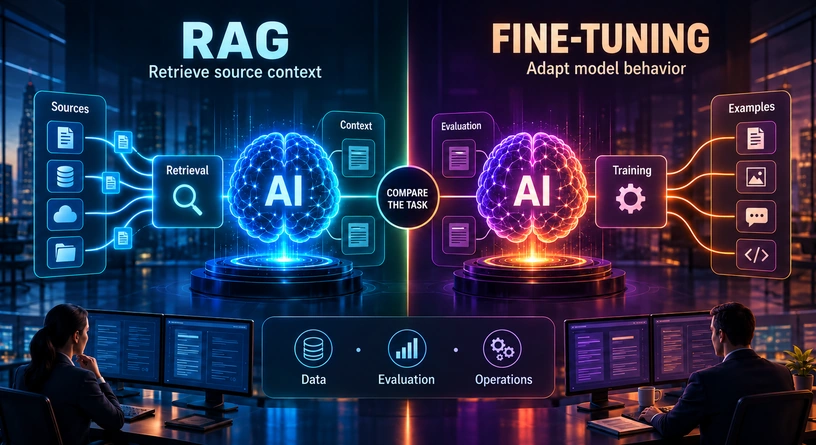
RAG and fine-tuning address different needs in an AI application. Retrieval supplies information at request time; fine-tuning adapts model behavior through additional training. The right choice depends on the task, changing data, evaluation results, and operating constraints. Define those needs before committing to an architecture.
A model may not have access to current internal information, and it may not respond in the format or style a task requires. These are separate problems. Retrieving an approved report can provide evidence for a summary, while adaptation may help with consistent behavior. Neither approach guarantees that the final answer will be correct.
Start with a baseline and clear tests. Compare quality, permissions, latency, maintenance, and total cost rather than declaring one technique universally superior.
This guide explains the roles, trade-offs, and combination of RAG and fine-tuning. Use it to identify what your application needs and which assumptions to test. For the broader delivery process, read our guide to generative ai software development.
Chapter 1: Define the Data Gap
Training does not give a model automatic access to current internal records. Answers also depend on the context and tools available in the application. Identify which information is needed and who may use it.
Company information may live in documents, business systems, or code repositories. Decide which sources are authoritative, how often they change, and whether the task needs a document search or a live system query. Keep source access separate from permission to disclose or act on the information.
Retrieval, structured tool access, prompting, and tuning may each help different parts of the workflow. If you need support assessing the options, discuss the scope with a generative ai application development team using your actual data and evaluation criteria.
Chapter 2: How Retrieval-Augmented Generation Works
RAG provides retrieved context to a model so it can answer using information outside its training.
Search permitted sources and supply selected results with the question. The model then generates a response. Retrieval may return incomplete, stale, or irrelevant material, so evaluate evidence and answers rather than assuming search found the truth.
Separate Search and Generation
A common design has source preparation and runtime retrieval stages, each needing its own tests:
Stage 1: Prepare Sources
- Source Intake: Read approved documents and records, retain source identifiers, and apply access requirements.
- Chunk Selection: Split material into useful units and test the boundaries.
- Create Embeddings: When vector search is used, an embedding model represents content numerically. Evaluate how well it supports your actual queries and document types.
- Search Index Storage: Store content and metadata in a suitable system with update, deletion, and permission controls.
Stage 2: Retrieve and Generate
- Process Queries: Prepare queries for the chosen search method and clarify ambiguity where needed.
- Relevant Search: Find candidate material using suitable vector, keyword, hybrid, or other methods. Apply access filters and assess support for an answer.
- Context Assembly: Supply relevant source material with instructions that distinguish evidence from untrusted commands.
- Response: Generate the answer, evaluate support, and use a fallback when evidence is insufficient.
Grounding Helps, but Errors Remain
RAG can provide current information without retraining model weights, but freshness depends on the source and update pipeline. Retrieval does not force every generated statement to be correct. Test missing and conflicting sources, access filtering, and unsupported questions. When policies change, verify indexing and answer behavior rather than assuming an update propagates instantly.
Limit Source Access
An answer can expose information even if the underlying database is private. Enforce permissions during retrieval and disclosure, review what reaches the model, and test cross-user access. Do not rely on a prompt to separate confidential records.
Include enterprise generative AI security and data-flow review in the retrieval design from the start.
Chapter 3: What Fine-Tuning Changes
Fine-tuning adapts a pretrained model or trainable components using examples. It may support task behavior, style, or output patterns. Define the desired change and test it against a baseline.
Training modifies the parameters selected by the method. Full tuning and parameter-efficient approaches have different resource and deployment requirements; neither should be chosen without evaluation.
Choose a Tuning Method
PEFT can adapt selected parameters or added components. LoRA and quantization-based approaches may reduce resource needs, but training still requires suitable data, evaluation, and operations planning. Hardware depends on the model and configuration.
Compare resource use and task quality, including behavior outside the training examples. Lower memory requirements do not remove the need to test regressions, data suitability, and deployment compatibility.
When Does Adaptation Help?
If the main problem is frequently changing facts, an approved source lookup is often a more direct way to supply them. If the problem is consistent task behavior, tuning may be worth testing. Avoid expecting training to act as a perfectly editable database or guarantee recall of every supplied fact.
Test tuning against specific behavior goals.
- Style Goals: Adapt response style while preserving factual checks and scope.
- Task Examples: Train on appropriate examples for a defined coding or classification task, then evaluate unseen cases.
- Structured Output: Improve format consistency where useful, while still validating outputs before downstream use.
Hosting and tuning are separate choices. Compare open-source vs proprietary models for the task, data requirements, and operating model. Self-hosting does not require fine-tuning, and tuning alone does not establish privacy.
Chapter 4: Compare Against the Same Requirements
Use the comparison below as a planning aid, not a set of guaranteed outcomes. Measure the chosen implementation with realistic data, workload, and access requirements before deciding.
| Decision Factor | Retrieval-Augmented Generation (RAG) | Model Fine-Tuning |
| Typical Goal | Provide source context for questions and document tasks. | Adapt task behavior, style, or response patterns. |
| Source Updates | Depends on ingestion, indexing, and source refresh. | Training updates behavior; source lookup may still be needed. |
| Accuracy Risk | Retrieval and generation both need testing; errors remain. | Evaluate learned behavior and unsupported answers; errors remain. |
| Delivery Effort | Depends on sources, access controls, and evaluation. | Depends on data preparation, training, evaluation, and deployment. |
| Resource Needs | Search, storage, model inference, and pipeline operation. | Training or adaptation resources plus inference and maintenance. |
Chapter 5: Estimate Full Lifecycle Costs
Compare implementation and operation together. Query volume, model choice, source size, updates, and support all affect cost.
- Retrieval Costs: Include source preparation, indexing, storage, search, reranking where used, model inference, and maintenance. Retrieved context can increase request size. Test selection and caching carefully, and measure cost against answer quality rather than assuming a particular database or prompt length is always appropriate.
- Adaptation Costs: Include dataset preparation, training, evaluation, deployment, and updates. A tuned model may change inference requirements, but savings depend on workload and quality. Compare actual options instead of assuming a smaller self-hosted model always costs less than a hosted service.
Include these trade-offs in your custom generative ai development cost. Separate initial delivery from recurring costs, and confirm accounting treatment with the finance team where needed.
Chapter 6: Combine Techniques Only When Useful
A hybrid approach may help when the application needs both task adaptation and retrieved information. It is an option to test, not a requirement for every enterprise system.
Evaluate whether the combination improves the target task enough to justify its added complexity.
- First, establish a baseline and test whether tuning improves the required behavior without unacceptable regressions. Use suitable training and evaluation data.
- Assess retrieval with the same permission, freshness, and evidence checks used for an untuned model. Compare combined results with simpler alternatives.
Combining techniques does not guarantee flawless answers. Plan source updates, model versions, monitoring, and failure recovery. Where demand warrants it, design a scalable LLM architecture for measured demand and reliability needs.
Scope Your Enterprise AI with DigiWeta
Begin with the business task, data sources, and acceptable failure behavior. These requirements determine which skills and architecture choices matter more than a preferred model or framework.
Discuss custom generative ai development services with DigiWeta around your current workflow and evidence needs. Compare retrieval, prompting, tuning, and integration options against a testable scope. Agree how quality, access controls, cost, and operating ownership will be evaluated before extending the system.
Ready to compare approaches for your use case? Contact DigiWeta to discuss scope and evaluation.
Frequently Asked Questions
RAG supplies retrieved information during a request; fine-tuning adapts selected model parameters or components using training examples. They address different needs and can be combined. Evaluate the application as a whole rather than assuming either technique guarantees accurate answers.
No. Retrieval can provide supporting evidence and tuning can affect behavior, but both need evaluation. Sources may be wrong or missing, and generated answers may remain unsupported. Define fallbacks and human review appropriate to the consequences of error.
For frequently changing records, a source lookup may be a more direct way to provide current information. Tuning can affect learned behavior but is not a perfectly editable database. Compare approaches with your actual update and evaluation requirements.
It may help when the task needs adapted behavior and source context. Test whether the combined approach improves quality or operating results over simpler options. Include extra training, retrieval, maintenance, and failure handling in the comparison.
There is no universal answer. Include data preparation, search or training, inference, infrastructure, evaluation, and maintenance. Compare realistic usage scenarios and equivalent quality targets. A lower initial build cost does not necessarily mean lower long-term operation.
Compare sources, permissions, retrieval quality, updates, workload, and maintenance. Vector stores, database extensions, keyword search, or hybrid designs may fit. Use representative tests instead of treating one framework or vendor as mandatory.
It depends on the architecture. Retrieved excerpts may be sent to a model provider even if the search database is private. Map every recipient, log, and storage location; verify permissions, terms, and retention. Self-hosting can change that flow but does not automatically eliminate exposure or security risk.
PEFT refers to parameter-efficient adaptation methods. LoRA trains low-rank adapters; QLoRA combines quantization of the base model with adapter training. They can reduce adaptation resource needs compared with some full-tuning setups, but suitability, quality, and deployment requirements still need testing.