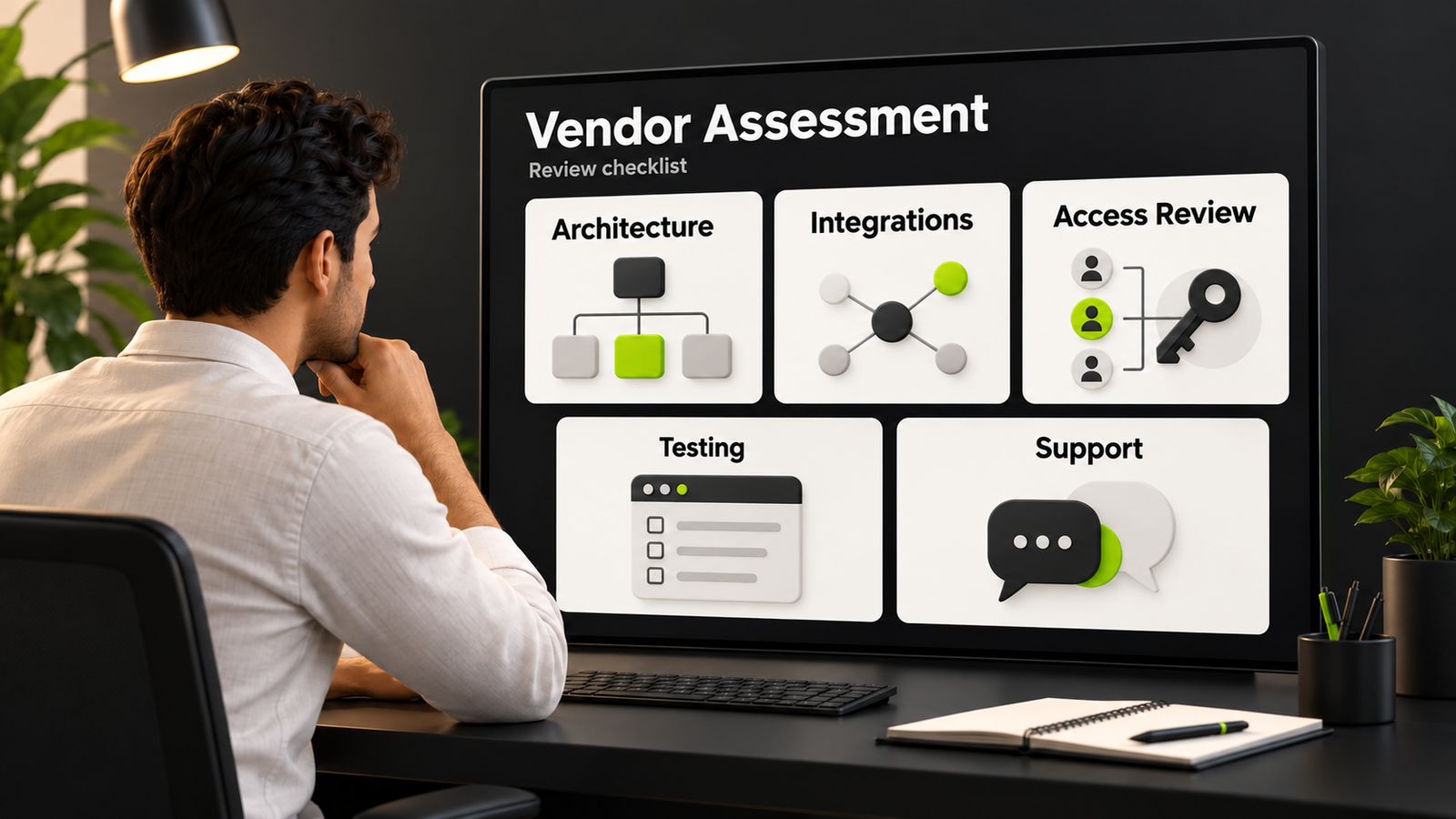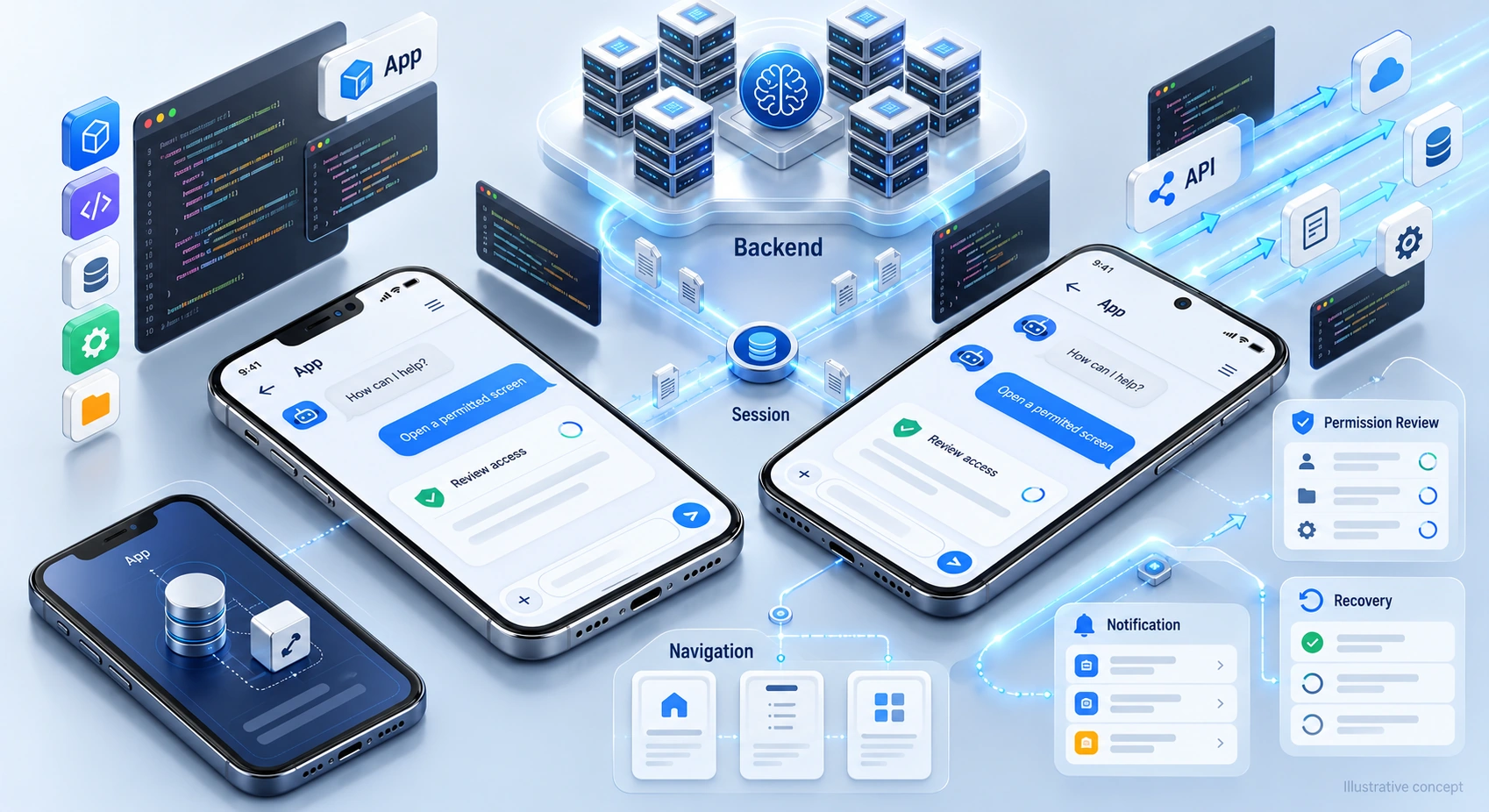


Healthcare and financial services use sensitive information and make decisions that can materially affect people. Generative AI projects in these settings need a defined purpose, clear limits, and appropriate oversight before potential benefits can be assessed.
Errors are not limited to incorrect wording. An assistant may omit an important fact, expose a record, or imply that a decision has been approved. Review the full workflow and consequences, and do not assume that a plausible answer or polished interface is ready for consequential use.
Define supported tasks, verify important outputs, and keep clinical or financial authority within appropriately governed processes.
This guide outlines possible applications and the questions needed to evaluate them. It is not medical, investment, or legal advice, and the examples are not guaranteed outcomes. For the wider delivery context, see our generative ai software development trends.
To scope a regulated-industry project with DigiWeta, discuss custom generative ai development services alongside your governance and review requirements.
Chapter 1: Define Applicable Duties and Controls
Identify the intended use, data recipients, organizational roles, and relevant obligations before selecting services. Product labels and hosting choices do not establish compliance. Involve qualified clinical, financial, privacy, security, and legal reviewers as appropriate.
Healthcare Privacy Review
For ePHI-related projects, assess the actual arrangement, safeguards, agreements, and operating practices. The review should cover more than one feature or deployment label:
- Identify required BAAs and related responsibilities where applicable.
- Minimize data, control access, and test any masking or redaction instead of assuming it removes every identifier.
- Compare deployment choices against the requirements and verify external dependencies. Private clouds are not automatically air-gapped or compliant. For data-flow and access considerations, review preventing enterprise AI data leaks.
Financial Services Governance
Determine which requirements apply to the institution, activity, and jurisdiction. Define evidence, supervision, records, and review responsibilities for the intended use. Source citations can help reviewers examine an answer, but they do not alone authorize investment advice, lending decisions, or transactions. Keep consequential decisions in appropriately governed workflows and test that the assistant cannot exceed its role.
Chapter 2: Evaluate Financial Service Use Cases
Potential use cases should be evaluated against accuracy, review effort, access controls, and the consequences of error.
Support KYC and AML Review Work
Analysts may work with reports, records, and other sources under established review procedures. Identify a specific information-processing task before introducing a generative tool.
- Possible Role: Draft a source-linked summary for an authorized analyst. Check completeness, attribution, and unsupported claims. The draft must not independently determine a person’s risk status, deny services, or replace required investigation and approval.
Organize Market Research Material
Models may summarize reports or classify text for review. That does not prove reliable market predictions or trading signals.
- Possible Role: Summarize selected filings or transcripts with source references and visible uncertainty. Review the context and avoid treating inferred tone as a verified fact about an executive or company. Test the research workflow separately from any investment decision or trading action.
Assist Financial Professionals
Drafting support is not authorized personalized financial advice.
- Possible Role: Help a qualified professional prepare or organize permitted information. Any client recommendation needs the appropriate suitability, regulatory, and professional controls. Do not present generated strategies as mathematically correct or assume that adding a disclosure makes advice suitable.
Chapter 3: Evaluate Healthcare Workflows
Define the purpose and risks, then measure the workflow rather than assuming AI reduces burnout or improves care.
Summarize Records for Review
Long records can be difficult to navigate. A summary tool should be assessed for what it preserves, omits, and incorrectly adds.
- Possible Role: Draft a source-linked summary for clinician review. Test omitted allergies, conflicting records, dates, and unsupported conclusions. Do not replace necessary record review or promise fixed preparation-time savings.
Draft Clinical Documentation
Documentation assistance needs permission, privacy controls, validation, and a clear approval process.
- Possible Role: With the required permissions and policy controls, draft notes from a consultation for review. Check omissions, attribution, and invented details before finalizing the record through the authorized EHR workflow. A familiar note format does not make the content accurate or compliant.
Support Research and Drug Development
Validate research uses in context rather than promising shorter timelines for every project.
- Possible Role: Specialized models may propose candidates or help analyze research data. Outputs still require appropriate scientific evaluation and development processes. A generated molecule is not evidence of safety, effectiveness, or readiness for clinical use.
Chapter 4: Manage Unsupported Outputs
Errors can have serious consequences in these domains. Define what the system must not decide and how uncertain output is handled. Measure failures against realistic cases before release.
No prompt or architecture guarantees error-free output. Combine appropriate controls, evaluation, and professional oversight.
Retrieve Evidence with Controls
Retrieval can supply approved source material, but it can miss relevant information or return conflicting records. Apply access restrictions, preserve source references, and check whether an answer follows the evidence. RAG does not mathematically force accuracy, and citations should be verified rather than treated as proof by themselves.
Check and Escalate
Rules, validators, model-based checks, and human review may each help. Test what they miss and when they reject valid content. A second model is not an infallible judge. Define a safe fallback for unsupported or uncertain results instead of letting the system confidently fill gaps.
Measure the effects of review and validation on latency, capacity, and cost when planning a scalable LLM architecture for your workload and risk requirements.
Chapter 5: Keep Service Assistance Within Scope
Service workflows may be useful starting points when the information, actions, and human handoffs are clearly defined.
Financial Service Assistance
Guide users to approved information and supported banking processes. Account access and financial actions need institutional controls. Preserve human support; do not let a language model authorize transfers or invent account facts.
Healthcare Information and Scheduling
Administrative information and appointment support differ from symptom assessment or clinical triage. Define that boundary explicitly. Symptom-related functions require appropriate validation, clinical governance, and regulatory review. Do not let an open-ended assistant infer that waiting is safe or select treatment from a casual exchange.
Test the limits, failure behavior, and escalation routes of customer-facing tools. For related interaction and handoff considerations, review our guide to building automated customer support chatbots.
Chapter 6: Measure Benefits and Costs
Budget for delivery, integrations, evaluation, privacy and security review, operations, and support. Include output review and exceptions. Architecture and accounting treatment depend on the project.
Benefits need evidence from the intended workflow, not broad industry promises.
- For documentation support, measure preparation, correction, approval time, and quality. Time saved in one step may be offset by review elsewhere. Do not automatically count freed time as recovered revenue.
- For analyst assistance, measure useful completed work, error rates, and review effort instead of assuming every report can be automated.
Compare observed benefits with full costs over the same period. Show uncertainty and use pilot evidence to refine the forecast. Review our enterprise generative AI costs when organizing the budget.
Scope Regulated-Industry AI with DigiWeta
Begin with a narrow use case, accountable reviewers, and clear boundaries. Validate the workflow before extending data access or assigning more consequential tasks.
For teams evaluating generative AI development services in the USA, discuss your requirements with DigiWeta. Agree the purpose, data controls, evaluation criteria, specialist review, and operating ownership. Compliance and safety require assessment of the actual implementation; no model or architecture guarantees flawless execution.
Ready to review the requirements? Contact DigiWeta to discuss a scoped project and appropriate review responsibilities.
Frequently Asked Questions
Intended use, evidence, controls, oversight, and applicable requirements determine suitability. Assess the full workflow with qualified stakeholders. Private hosting, retrieval, or redaction alone does not establish safety or compliance, and a general-purpose model should not replace clinical or financial authority.
Review organizational roles, applicability, data flows, recipients, safeguards, agreements, and ongoing practices. Confirm required BAAs where relevant and evaluate actual service settings. Hosting locally or signing an agreement alone does not complete the assessment; involve qualified privacy and security reviewers.
No. Retrieval and checks may reduce some errors but can still fail. Define narrow uses, test representative cases, preserve evidence, and involve qualified reviewers where consequences require it. Do not call a system error-free because it uses RAG or a second model.
Confirm required permissions and privacy controls, then have the responsible clinician review the draft for omissions, inaccuracies, and attribution before approval. Use authorized record workflows and measure actual review effort. A structured note is not automatically correct or compliant.
Tools may organize permitted sources or draft summaries for analysts. Check evidence, completeness, and unsupported claims. Preserve established investigation and approval processes; do not let a general-purpose assistant assign consequential risk status or deny financial access.
Internal teams, external specialists, or a mixed model may contribute. Assign clinical or financial, legal, privacy, security, and technical responsibilities as appropriate. Evaluate evidence, capacity, support, and handover rather than assuming an agency or template guarantees compliance.
Do not treat a general-purpose chatbot as a qualified investment professional. Personalized recommendations require appropriate professional and regulatory controls. Obtain specialist review of the intended service; a confident output, risk disclaimer, or source citation alone does not establish suitability or compliance.
Estimate the chosen workload, data handling, evaluation, safeguards, hosting, and support. Include specialist review and ongoing operations. Use current quotes and realistic scenarios; no standard GPU configuration or generic monthly price establishes that the system is compliant.