
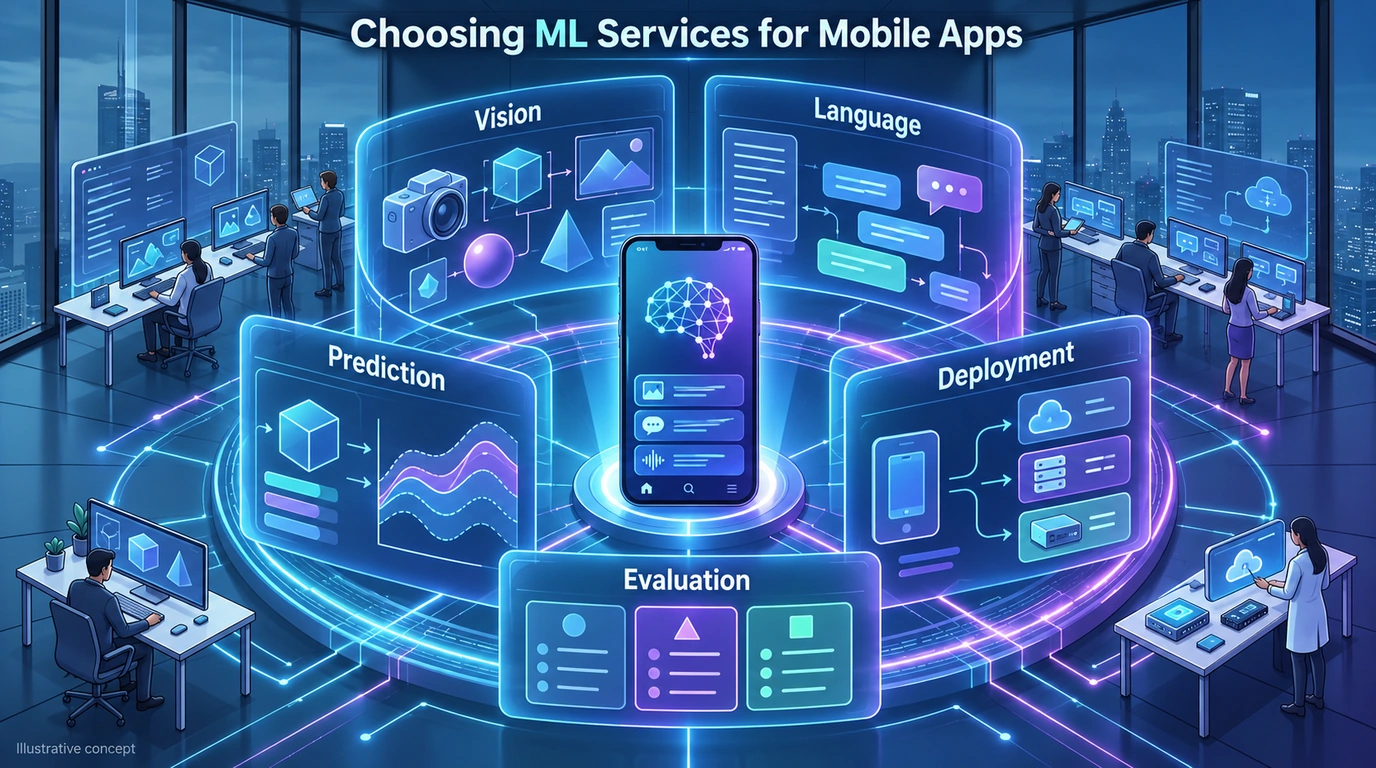
Start with the problem your mobile application needs to solve, rather than a request to add AI. Machine learning is one approach to identifying patterns in data and supporting useful application features.
Model selection depends on the task, available data and evaluation criteria. Broad labels such as language model or computer vision do not establish suitability. Compare candidate approaches using representative examples, including difficult cases, rather than assuming one model category can or cannot handle every related task.
A poor model choice can create unnecessary complexity, slow responses or unpredictable operating costs. Evaluate quality and deployment requirements together before committing to an architecture.
This guide examines model-selection considerations for visual tasks, language features and predictions. Begin with the user’s decision or workflow, define what a useful result looks like and identify how errors will be detected and handled.
Model evaluation belongs within the AI application development lifecycle, alongside interface design and deployment planning. When choosing a machine learning app development company, ask how the team will compare approaches, test representative data and document limitations for your mobile application.
Chapter 1: Computer Vision (Seeing the World)
Computer vision may be relevant when an application interprets images or video. Define the visual task before selecting a model or processing location.
The Algorithm: Convolutional Neural Networks (CNNs)
Convolutional neural networks are one family of models used for visual data. Their suitability depends on the task and available training or evaluation data. Compare candidate methods against the application’s requirements rather than treating one architecture as the default for every image feature.
Mobile App Use Cases for Computer Vision:
- Object Detection & Classification: A shopping application might use image analysis to find visually related products. Test matching quality and explain that suggestions may not be exact.
- Facial Recognition & Biometrics: Identity-related image analysis needs careful evaluation, appropriate safeguards and a defined review process. A model alone does not establish secure identity verification.
- Pose Estimation (Real-Time Tracking): When building an AI fitness app, assess whether movement analysis is reliable enough for the intended feature. Camera conditions, device performance and user variation affect the design; do not imply that pose output is a medical or safety assessment.
The Engineering Challenge: Image and video processing can place demands on memory, compute and connectivity. Compare local and remote processing on representative devices and networks. Review Edge AI and CoreML as deployment options, without assuming either approach guarantees instantaneous results or acceptable battery use.
Chapter 2: Natural Language Processing (Understanding Human Text)
Language models may support chat, summarization, extraction or translation. Match the approach to the required inputs, outputs and review process.
The Algorithm: Transformer Architectures and LLMs
Transformers are widely used for language tasks, but the architecture label does not establish a model’s accuracy or suitability. Evaluate candidate models on relevant examples, including ambiguous requests and incorrect outputs. Consider data handling, response time and application integration alongside output quality.
Mobile App Use Cases for NLP:
- Conversational Interfaces (Chatbots): A support interface can interpret a request and propose the next step. Consequential actions, such as canceling a booking, need appropriate authorization and confirmation rather than being triggered solely by a model’s interpretation.
- Data Extraction & Summarization: Document tools can propose extracted fields or summaries. Important details should remain traceable to the source and open to review.
- Ambient Clinical Documentation: Speech and language tools may assist with draft documentation. Clinical information needs review by authorized professionals, and the application must address applicable privacy and operational requirements. Automated transcription does not itself establish record accuracy or compliance.
Chapter 3: Predictive Analytics and Recommendation Engines
Predictive and recommendation features use data to estimate outcomes or rank options. Define the decision they support and how usefulness will be evaluated.
The Algorithms: Collaborative Filtering and Deep Learning
Predictive work often uses structured records, though inputs and methods vary with the particular forecasting or ranking task.
- Collaborative Filtering: Recommendations can use patterns across users or items to suggest potentially relevant options. Evaluate coverage and usefulness, including situations with limited history, rather than assuming past behavior reliably predicts each person’s next choice.
- Deep Learning Recommenders: Neural models can combine different inputs for ranking tasks. Use only appropriate data and test whether added complexity improves results compared with simpler alternatives.
Mobile App Use Cases for Predictive ML:
- E-Commerce and Media: Product or content recommendations can help people explore available options. Measure relevance and unwanted effects rather than promising increases in engagement, retention or customer value.
- FinTech and Fraud Detection: Anomaly detection may flag activity for review. Define acceptable errors, escalation rules and decision responsibilities. An unusual transaction is not automatically fraudulent, and a model score alone should not imply a verified finding.
- Dynamic Pricing: Pricing models may consider demand and operational inputs. Define business rules, oversight and evaluation before allowing predictions to influence customer-facing prices.
Chapter 4: Traditional Machine Learning (Regression & Classification)
Established machine learning methods remain useful. Start with approaches that suit the data and decision rather than choosing deep learning by default.
A simpler model can be easier to evaluate and operate for some tasks. Compare it with more complex alternatives using relevant quality, resource and maintenance criteria.
The Algorithms: Linear Regression, Random Forests, and SVMs
- Regression Models: Regression estimates numerical outcomes. A property application might estimate a value from relevant attributes, but the result remains an estimate with limitations rather than an exact future sale price.
- Classification Models: Classification assigns inputs to defined categories. An email feature might label suspected spam, for example. Evaluate mistakes and provide suitable ways to review or correct classifications.
The Engineering Advantage
Deployment requirements vary even for relatively compact models. Check runtime compatibility, memory, processing time and device behavior before deciding whether a model belongs in the application or a remote service. A simpler algorithm does not guarantee immediate responses or eliminate operational work.
When reviewing the architectural differences between traditional and AI apps, compare model complexity with the value it adds. Choose an approach that meets the task’s measured requirements rather than assuming a larger model is better.
Chapter 5: The Model Deployment Lifecycle (MLOps)
A useful experiment still needs an application delivery plan. Define how inputs reach the model, how outputs are returned and reviewed, and how the deployed feature will be monitored and maintained.
Bridging the Gap Between Data Science and Mobile Dev
Plan model delivery and ongoing operations.
- API Containerization: For remote inference, define the service interface, deployment environment and access controls. Containerization may be useful, but the technology choices should follow the application’s operational requirements rather than a fixed stack.
- Model Quantization: Model optimization can reduce resource requirements, but may affect output quality. Test supported deployment formats and runtime behavior on target devices before accepting a converted or compressed model.
- Continuous Monitoring (Data Drift): Monitor relevant input and output measures after release. Investigate changes before deciding whether retraining is appropriate. Data collection and model updates need documented permissions, evaluation and release controls rather than silent automatic reuse.
Build Intelligent Mobile Apps with DigiWeta
Mobile machine learning brings together model evaluation, application engineering and product design. Assess a delivery team’s relevant experience and proposed responsibilities instead of assuming that a particular agency label guarantees or excludes those skills.
DigiWeta’s machine learning app development discussions cover the user workflow, available data and deployment requirements. Define the scope of model evaluation and mobile integration together, with clear acceptance criteria and documented limitations rather than promises of a perfect algorithm or zero-latency performance.
Discuss your application requirements with DigiWeta and plan an evaluated, maintainable machine learning feature.
Frequently Asked Questions
AI is a broad field concerned with systems that perform tasks associated with intelligence. Machine learning is an approach within that field that learns patterns from data. Applications still need explicit rules, interfaces and review processes around model outputs.
Consider computer vision when the feature needs to interpret visual information. Define whether the task involves identification, detection or movement analysis, then test suitable approaches. Not every camera feature needs a learned model.
A recommendation system ranks or suggests items using available information. Its usefulness depends on the task, data and evaluation. Recommendations do not guarantee retention or sales, and users should have appropriate control over the experience.
There is no single model that is automatically suitable for every application task. Evaluate the specific model, supported input types and measured results. A general-purpose model may help with some workflows but still require additional components, safeguards or a different method.
Deep learning uses multilayer neural networks. Other machine learning approaches include methods such as regression and tree-based models. The best choice depends on the task, data and evaluation; neither category is universally superior for a particular dataset size or format.
They can affect responsiveness, memory use and battery consumption. Remote processing also introduces network dependencies. Test representative devices, workloads and connections, and consider model optimization or architectural changes when measurements show a problem.
Choose a runtime supported by the target Apple platform and verify that the model can be integrated correctly. Conversion and optimization requirements depend on the model and toolchain. Test outputs, memory and response time on supported devices rather than assuming conversion alone completes deployment.
Data drift describes changes in inputs relative to earlier data. Such changes may affect model quality, but require investigation. Monitor relevant measures and evaluate potential updates before release; retraining is not an automatic remedy for every observed change.