
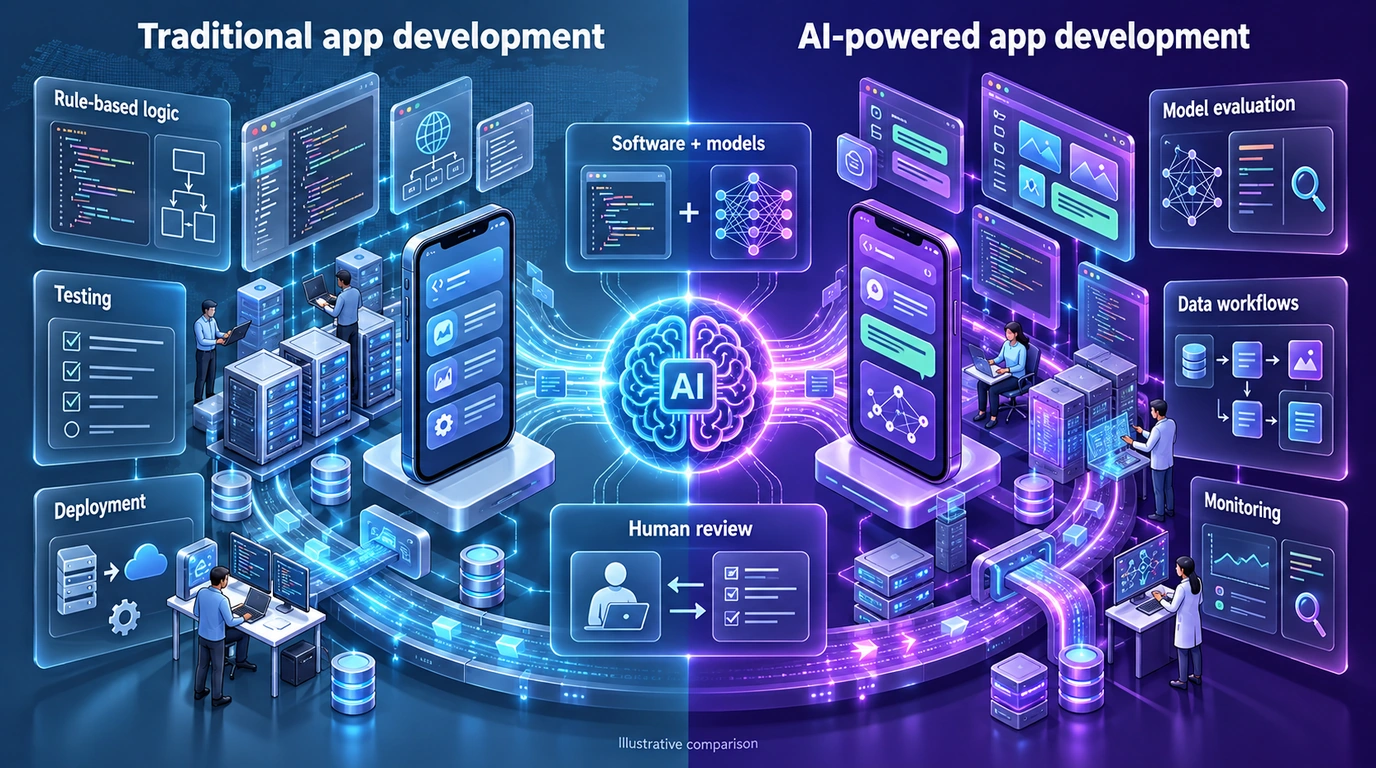
When considering AI vs traditional software applications, the key difference is in the way they come up with an output. Traditional software works based on rules made by developers, whereas AI-based software learns through data and machine learning algorithms to identify patterns, make predictions, or understand complicated data.
There is no need to think that one approach is better than the other. Traditional software suits cases where there is a need to perform repeatable and predictable operations. AI helps when the business needs to handle ambiguity, unstructured data, changing patterns, or decisions which cannot be described using rules.
Sometimes, a business needs to combine these two approaches. Traditional software will ensure reliability, whereas artificial intelligence will provide predictions, personalization, language recognition, or smart automation.
DigiWeta offers AI application development services to businesses which need to integrate these features into their business solutions securely.
AI and Traditional Software at a Glance
| Comparison area | Traditional software | AI-powered software |
| Core logic | Rules written by developers | Patterns learned or inferred from data |
| Output | Predictable and repeatable | Probabilistic or confidence-based |
| Best input | Structured, clearly defined information | Structured or unstructured data |
| Ideal tasks | Calculations, transactions and fixed workflows | Prediction, classification, generation and pattern recognition |
| Data dependency | Uses data to execute programmed rules | Uses data to train, ground or guide models |
| Testing approach | Confirm expected output for defined inputs | Evaluate quality, accuracy, risk and performance ranges |
| Updates | Code and rule changes | Code, model, data, prompt or retrieval updates |
| Explainability | Usually easier to trace | Can require additional explanation methods |
| Maintenance | Fix defects and update features | Maintain software plus data and model performance |
| Common architecture | Deterministic application logic | Usually a hybrid of software and AI components |
The practical choice is not “modern technology versus old technology.” It is a decision about which type of system best matches the business problem.
Key Differences Between AI & Traditional Software Programs
Both traditional and AI-based programs require proper architecture, coding, testing, implementation, and design in accordance with users’ needs. AI is not a replacement for conventional software development.
Instead, it adds a further level of data, model building, assessment, and execution complexity. Recognizing the differences allows companies to assess costs, risks, and choose proper architecture.
Rule-Based Logic vs Data-Driven Learning
The traditional approach involves the application of logic.
This means that the developers define what the program is supposed to do in specific situations.
For example:
- When the amount on the invoice surpasses a pre-approved limit, then ask for further authorization.
- When the entered password fails five times in a row, block the account.
- When the quantity of stock becomes less than the minimum requirement, then generate a replenishment warning.
- When the customer chooses any item, determine its price using the set rules.
The software does not discover these rules. It executes the instructions created by developers and business stakeholders.
Machine learning functions differently. Rather than hard-code all the rules, machine learning engineers give it data and the goal it should achieve. Patterns in the data will help the model understand how to classify information, predict an outcome, or suggest an action.
For example, a fraud detection model might look at the transaction amount, location, device, time of transaction, customer behavior, and patterns of fraud. It might find combinations that are hard to describe using hundreds of rules.
That is the core difference between machine learning and traditional software: a regular application runs code, while a machine learning system predicts outcomes based on patterns.
Deterministic vs Probabilistic Outputs
The typical software application is deterministic. When a consistent input passes through a consistent version of the software, under the same conditions, the software should produce the same result.
These qualities make it appropriate for traditional systems to be used in:
- Money calculations
- Authentication and authorization
- Transactions processing
- Regulation
- Stock updating
- Wage calculations
- Database queries
- Consistent approval process
AI results are often probabilistic. A model could provide a prediction, assign a confidence level to a prediction, rank possible suggestions, or provide varied text in response to a similar request.
These capabilities allow AI applications to work with language, images, behaviors, and partial data. On the other hand, they require organizations to specify performance boundaries rather than test their software against one consistent result.
Probabilistic is not synonymous with random or unusable. It simply means that the quality is judged statistically and managed according to the risk of the application domain.
Structured Inputs vs Unstructured Information
Typical software works best where data is structured according to certain expectations. A form, a record in a database, a transaction, or an API call provides clear labels for the data values that need processing.
The following list shows the challenges of working with data when it appears in one of these forms:
- E-Mails
- Contracts
- Customer dialogues
- Product reviews
- Medical imagery
- Audio files
- Scanned data
- Video
- Free-form questions
Using AI, the program could be able to classify, summarize, extract, understand or produce unstructured data in these formats. Text can be processed using natural language processing, while imagery and videos are understood by computer vision.
Nonetheless, the application still needs to have conventional software around the model.
Code Dependency vs Data Dependency
The conventional operation of software is determined primarily by its code, configuration, and business rules. A developer modifies the application using these three factors.
Similarly, an AI operation is determined by the data used. The quality, coverage, relevance, and governance of this data will have an impact on the application performance.
An AI application may be dependent on:
- Data for training purposes
- Validation data set
- Test data set
- Business documents
- Customer interactions
- Product/transaction data
- Prompt data
- System instruction data
- Indexing data
- Model configuration data
- Human feedback
New risks arise because the presence of incomplete, outdated, inconsistent, or biased data can cause poor performance despite the surrounding code being correct.
This is why AI development requires more collaboration between business experts, data engineers, AI engineers, the security team, software developers, and users.
Conventional Testing vs AI Evaluation
A conventional test checks whether the application fulfilled the defined requirement: if there were three products in an order, then the system had to use the specific formula for calculations.
AI evaluation raises additional questions:
- How good is the quality of the predictions?
- How often does the model fail to predict the critical case?
- How often does the model raise a false alarm?
- Does it perform equally well for all user groups?
- Is the prediction reasonable?
- What happens when the system receives unusual input data?
- Could the user comprehend or challenge the output?
- Does the application stay within its limits?
Prediction models could be tested on the criteria of accuracy, precision, recall, error rate, or any other task-specific criteria.
Generative AI applications need to be tested for accuracy, relevance, completeness, following instructions, safety, and grounding in the approved knowledge. Both automatic and manual evaluations might be required.
Costs associated with the wrong output affect the chosen approach to the tests: it makes no sense to run the same tests for product recommendation and risk management.
Software Updates Vs Continuous Model Oversight
A conventional software application will be updated by the developers to fix bugs, enhance security, or add more capabilities. If the environment is stable, the functioning of the software should remain reliable and predictable.
AI applications may become inefficient because of changes in the real world. The way customers behave, the way they commit fraud, terminology, products, the state of the market, or internal policies can change over time.
This means that maintenance of an AI application might require the following tasks to be performed:
- Model accuracy monitoring
- Data/model drift detection
- Output failure analysis
- Prompt/Guardrail updates
- Business document updates
- Index rebuilding
- Model retraining/replacement
- Model comparison
- Costs control during inference
- Latency/availability monitoring
In other words, the software lifecycle evolves into a data/model lifecycle which does not stop after deployment.
When considering the implementation of AI, businesses need to have an idea of the entire AI app development lifecycle.
Explainable Rules vs Model Interpretation
It is simpler to track traditional rules. If a transaction was denied because it went over a certain limit, then the system can determine which rule caused this decision.
It may be harder to interpret some AI models. This kind of model could use a lot of factors and patterns when making a prediction but not give an easily understandable reason for this prediction.
This is important in cases where an organization needs:
- Credit decision making
- Insurance decisions
- Support in healthcare
- Hiring
- Fraud detection
- Compliance checking
- Employee evaluation
The organization might need to have confidence scores, explanations and reasons for a decision, supporting evidence, human review, audit logs, and explanation approaches.
If a decision needs to be 100% transparent and reproducible independently, then traditional rules would be better. Another approach could be using AI to make a recommendation and having the workflow based on rules and controlled by a qualified employee.
Predictable Costs vs Usage-Dependent Costs
Traditional application costs typically cover design, engineering, infrastructure, licensing, support, and maintenance. Once deployed, the cost of processing another request could be more predictable.
Costs introduced by AI applications could include the following:
- Data prep
- Model training or customization
- Usage of the AI API
- Infrastructure
- Evaluation
- Human review
- Monitoring
- Model updates
- Data pipeline upkeep
- Governance & compliance
Cost of generative AI could depend on the number of requests, context length, output length, model selection, and tools used. Computer vision or predictive models could require special infrastructure for processing or training.
Nevertheless, AI can justify these costs through automation, better decision-making, or capabilities that fixed software cannot provide.
Compare total business value with total lifecycle cost rather than development cost alone.
When to Choose AI Over Traditional Solutions
Companies should consider using AI where the task demands learning, forecasting, interpretation, and generation of output. Incorporating AI into processes where plain rules will suffice is costly, risky, and valueless.
One should consider the nature of the process, outcome sought, data at hand, and risks of failure.
Choose Traditional Software When Rules are Clear
Traditional software is preferable in cases where:
- The logic can be known before implementation of the solution.
- Identical inputs will consistently yield the identical output.
- Precise computations are required.
- The process undergoes few changes.
- Auditability of decisions is necessary.
- There is no suitable training or reference data available.
- The wrong output may cause too much risk.
- The issue may be handled using a straightforward workflow.
These include payment calculations, user authentication, database operations, predefined approval rules, tax calculations, user permissions, and transaction processing.
Traditional software is no less sophisticated because it is not AI-enabled. In the appropriate case, it is safer, more efficient, testable, and affordable.
Select AI When the Problem Contains Ambiguity
AI is useful when developers cannot realistically write rules for all possible inputs and scenarios.
Good examples for applying AI include:
- Making predictions about future events
- Finding patterns within data
- Categorizing information that is variable
- Interpreting natural language
- Analyzing visual/audio/video media
- Creating summaries of text
- Recommendation systems
- Anomaly detection
- Action ranking
- Information extraction from unstructured sources
As an example, developers may try to write rules for every possible description of a support problem from a customer. However, human language is too variable to make this work at any reasonable scale.
The AI system can understand the query, classify the intent, find related knowledge, and make a recommendation. The rest of the process can be handled by traditional software.
Choose AI When Sufficient Data Exists
Machine learning algorithms require representative data or models trained previously. It is wrong for a company to assume that all records are valuable.
When selecting AI, the organization must first consider whether the existing data is:
- Related to the issue at hand
- Valid enough for the decision to be made
- Accessible to the development team
- Permitted to be used legally and ethically
- Representative of real users
- Recent enough for production
- Abundant enough
- Properly controlled
In the absence of suitable data, the team can either acquire it, improve its quality, change the scenario or simply avoid AI altogether.
When it comes to generative AI, the company does not have to train the algorithm itself but may still require valid documents, data about the business, proper instructions and retrieval of this information.
Choose AI When Errors Can Be Managed
Each AI application can produce inaccurate outputs. Thus, it is important for the company to know what the cost of any mistake will be before making the process automated.
Applying AI will be safe when:
- It is possible for the decision to be reviewed by a human being.
- Reversibility of the decision is possible.
- Thresholds can control automation.
- There is a fallback process.
- Evidence can be provided by the application.
- Error can be monitored.
- Risk cases can be escalated.
In simple decisions like product recommendation, the firm may choose to automate the process.
Use a Hybrid System When You Need Intelligence and Control
Most production AI applications are hybrid solutions. These use deterministic code with one or more AI functions.
For instance, take an insurance claims application:
- Deterministic software checks required fields and policy status.
- AI analyzes information in documents and images.
- Machine learning makes a risk assessment.
- The business rules decide whether the claims should be investigated.
- A claims agent analyses risky or unsure claims.
- Deterministic software logs the outcome and audit trail.
AI works with the information that cannot be processed via rules. Deterministic software ensures workflow control, record-keeping, and ultimate action control.
Hybrid architecture is also helpful in customer service. AI will analyze questions and suggest answers, while deterministic architecture will handle authentication, access rights, transactions, and escalations.
Use This Decision Checklist
When deciding on which technique to use, determine:
- Is the entire logic definable as dependable rules?
- Does the output have to be precisely the same for identical input?
- Is this a problem of prediction or pattern recognition?
- Is there language or image interpretation required for this application?
- Do we have the proper data or pre-existing model?
- What could be the consequences of an incorrect result?
- Can a human evaluate questionable results?
- Is an explanation for its decisions needed from the system?
- How will performance be evaluated?
- Will there be any oversight of the application post-deployment?
- Can we lower the risk through hybridization?
- Will the added value justify the complexity?
If the problem is well-defined and predictable, go with conventional software. If ambiguity and learned patterns are involved, then go with AI. If there is a need for both flexibility and control, then go with both.
Benefits of AI over Traditional Systems
There are several benefits in using AI in processes that could not be managed effectively by traditional approaches to software engineering. The benefits derive from the capability of processing complex information, analyzing patterns and operating on big data volumes.
It is important to notice that there is no inherent benefit without proper execution. Data, evaluation, integration, security, and end-user adoption will decide whether the application will enhance the business.
Automation of Complex Knowledge Processing Activities
Conventional automation works well if each of the steps of business automation is strictly defined. AI extends the concept of automation to language, documents, predictions, images, and classifications of knowledge.
AI can be used to:
- Document extraction and classification
- Customer requests analysis
- Reports summarization
- Information retrieval
- Visual control
- Fraud detection
- Forecasting demand
- Sentiment analysis
- Support ticket distribution
Predictive maintenance
These benefits of automation make it possible for companies to solve processes that before could not be solved due to the high variability of knowledge involved.
The best solutions do not automate everything. They automate predictable activities and forward exceptions to the right employee.
Finding Patterns Humans May Miss
Machine learning models can measure relationships across huge datasets more reliably than humans do.
The machine learning model can detect such patterns as:
- Anomalies in the transactions
- Early warnings about equipment failures
- Clients who are at risk of churn
- Trends in demand for products
- Defects in images
- Customer feedback trends
- Operational inefficiencies
- Similarities in cases or documents
These patterns may help organizations solve issues ahead of time. Nonetheless, the results provided by the model must not be taken as facts or truth.
Providing Personalized Experiences
Traditional applications allow personalizing experiences based on predefined groups. Each client within the defined category will get the same offer.
Machine learning allows achieving more complex personalization through behavioral, preference-based, contextual, and interaction-based analysis.
- Personalization in applications includes:
- Product recommendations
- Search results
- Learning experiences
- Communication with customers
- Financial recommendations
- Content discovery
- Responses to customers’ inquiries
- Next-best action recommendations
Personalization must work for the benefit of both the organization and the end-user. There should be organizational mechanisms to avoid intrusion and other ethical problems.
Processing Unstructured Information
Much of the information generated by businesses is not stored within structured databases. It comes from email, PDF files, presentations, support chats, images, video and reports.
AI can assist businesses with:
- Searching information semantically
- Extracting fields from documents
- Summarizing lengthy reports
- Classifying incoming requests
- Finding topics in feedback
- Transcribing and analyzing conversations
- Detecting objects or defects in images
- Generating answers using approved knowledge
This could result in easier access to institutional knowledge. It would also save time when copying information from one document to another.
Facilitating Better Decision Making
AI can analyze information and uncover pertinent patterns before a decision is made.
For instance, AI can facilitate:
- Prioritization of sales leads
- Identification of risky transactions
- Projections of inventory needs
- Detection of operational anomalies
- Comparison of supplier performance
- Summarization of customer history
- Predictions of maintenance needs
- Routing of urgent cases
Faster decision-making does not equate to eliminating human judgment. Rather, it means AI providing the information, confidence and context necessary for a well-informed response.
Adapting to Changing Patterns
Traditional software changes when developers update its code or rules. An AI model can be updated with fresh data if the behavior of customers, the operation of a company, or patterns in the marketplace have shifted.
This makes AI a candidate technology that can be applied in places where the old rules quickly become obsolete.
Adaptation is not something that automatically happens. Organizations need to keep track of their model’s performance, detect any drift, approve the update, and validate a new version.
An inadequately maintained AI model becomes increasingly unreliable. The companies should understand what difficulties exist in the process of AI development and not rely on the fact that the model will constantly improve by itself.
Developing New Services and Products
AI can help achieve certain capabilities that cannot be implemented without AI.
For example:
- Product assistants that can converse with people
- Smart document processing platform
- Visual search system
- Forecasting tools
- Learning system
- Copilot that helps find and process enterprise knowledge
- Applications with voice recognition
- Assisted-design applications
- Recommendation system
- Workflow agents
Increasing Employee Productivity
AI can help cut down employee time on finding, summarizing, categorizing, and processing information.
A business assistant could find approved documents, summarize relevant information, and give references. A sales solution could prepare the customer context before a conversation. A support app could recommend an answer based on customer’s history.
Employees will oversee making judgment, building relationships, strategizing, and handling sensitive situations. AI will provide them with quick access to information.
Scalability of Decisions and Experiences
Personalization and manual analysis become hard as transaction and customer numbers increase. AI is able to provide the same kind of assessment in many transactions.
Useful in cases when there is:
- A large catalog of products
- Support at high volume
- Monitoring of transactions
- Demand planning from multiple locations
- Document-heavy processes
- Large knowledge base
- Real-time recommendation systems
However, scalability also demands traditional engineering. Databases, APIs, queues, caching, authentication, cloud; all are part of the app.
AI vs Traditional Software Applications FAQs
What is the major difference between AI and traditional software?
In traditional software, the rules are explicitly coded by developers, whereas AI software operates using models to infer patterns from data or generate output based on context.
Traditional systems are generally deterministic, whereas AI systems provide predictions, probabilities, ranks, or generated responses.
Is AI always better than traditional software?
No. Traditional software outperforms when it comes to accurate calculation, fixed business logic, structured transactions, or any process which requires repeatable results.
AI excels when used for predictions, personalization, language, images, classification, and when every rule cannot be known in advance.
Does traditional software have elements of AI?
Yes. Most business AI applications consist of traditional software and AI.
The former controls the interface, accounts, permissions, databases, transactions, and workflows, and the latter includes predictions, recommendations, content generation, document understanding, and pattern recognition.
Is the cost of developing AI software higher?
It is possible for AI to incur additional expenses related to data preparation, model accessibility, training, testing, infrastructure, monitoring, and maintenance.
However, the cost will depend on the application scenario and architecture. Leveraging an existing model may be better suited than training one. In addition, a limited AI feature may prove cheaper than an extensive enterprise platform.
Is AI software less reliable compared to conventional software?
AI works differently rather than being less reliable in all cases. Conventional software provides deterministic outputs if its rules are right. AI provides outputs based on the model, which require evaluation using representative examples.
Reliability is determined by data quality, model performance, testing, guardrails, monitoring, and consequences of incorrect output.
Does AI software improve on its own?
This is not always the case. There are some software systems which get new data; however, they should not change their production behavior without controlled validation.
Performance should be monitored, feedback reviewed, modifications tested, and only then should changes in models or configuration be deployed.
Which approach is more secure?
Both approaches can be either secure or insecure based on the architecture and design implemented in each.
AI introduces some risks such as sensitive training data, prompt injection, model access, unsafe outputs, and self-service tool usage. These risks need control mechanisms apart from standard application security.
When should a business consider using a hybrid approach?
A hybrid approach should be used when an AI system is needed to interpret or predict data, whereas the rest of the process requires strict rules and controls.
For instance, an AI may analyze the document while traditional software will perform permission validation, approval, logging, and exception handling.
Will AI replace traditional business software?
AI will most likely add value to traditional software rather than substitute it. Companies will still need deterministic software for transaction processing, permission verification, calculations, logging, and workflow management.
AI may improve all that with prediction, personalization, natural language processing, and automation.
How should a business begin an AI software project?
Start by selecting one well-defined problem and a metric to measure the baseline. Find out whether the issue can be solved using rules before considering AI.
Afterwards, review the data you have, risk factors, system integration needs, security, value proposition, and need for human oversight. A well-constrained proof of concept may be used to validate the core assumptions.
Selecting the Right Technology to Solve a Business Problem
Traditional software offers predictability, precision, and control. AI offers pattern recognition, interpretation, prediction, and adaptation. Many of the best business solutions use both technologies. DigiWeta assists businesses in finding areas where AI can add value and situations where traditional development wins.