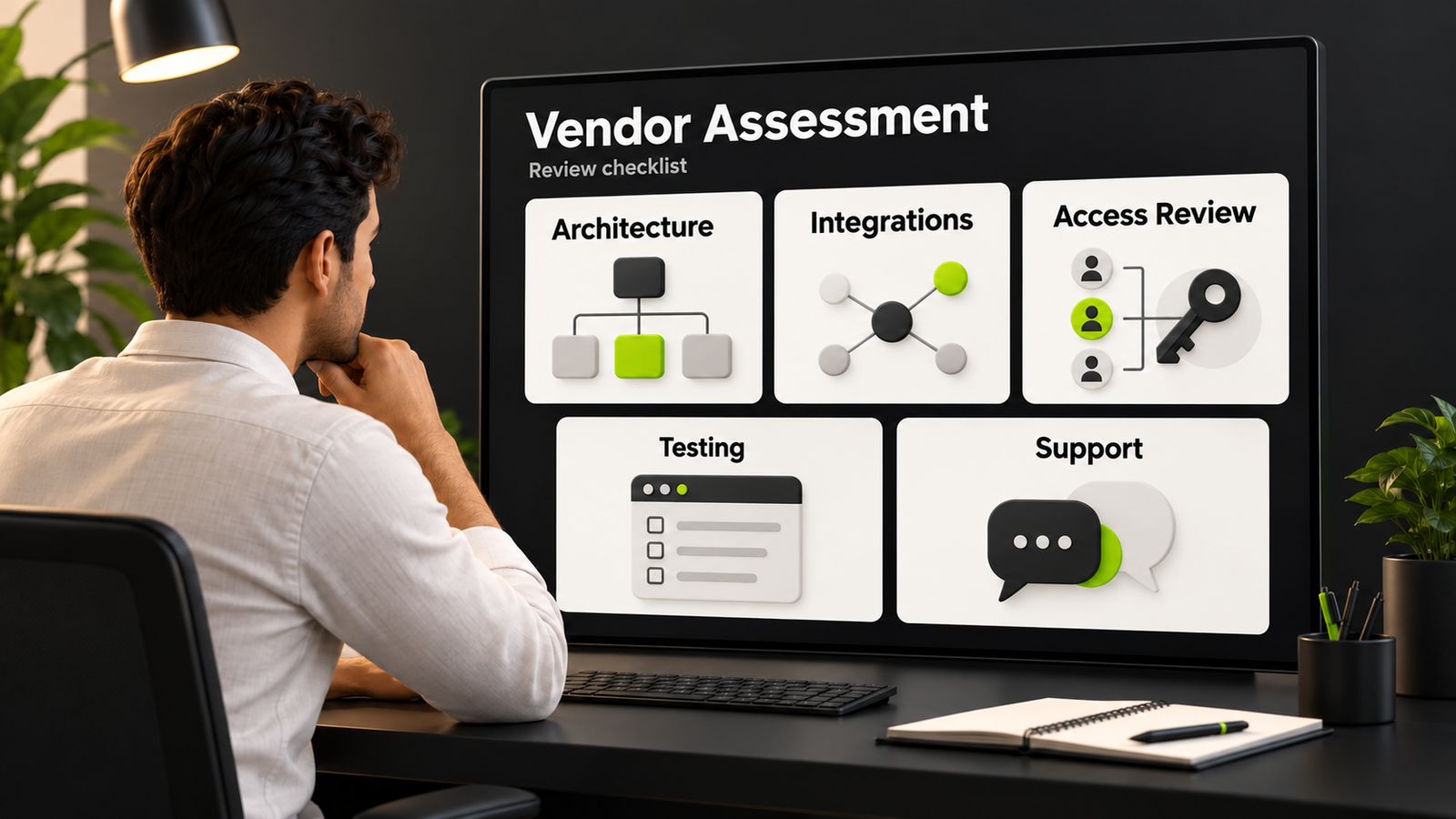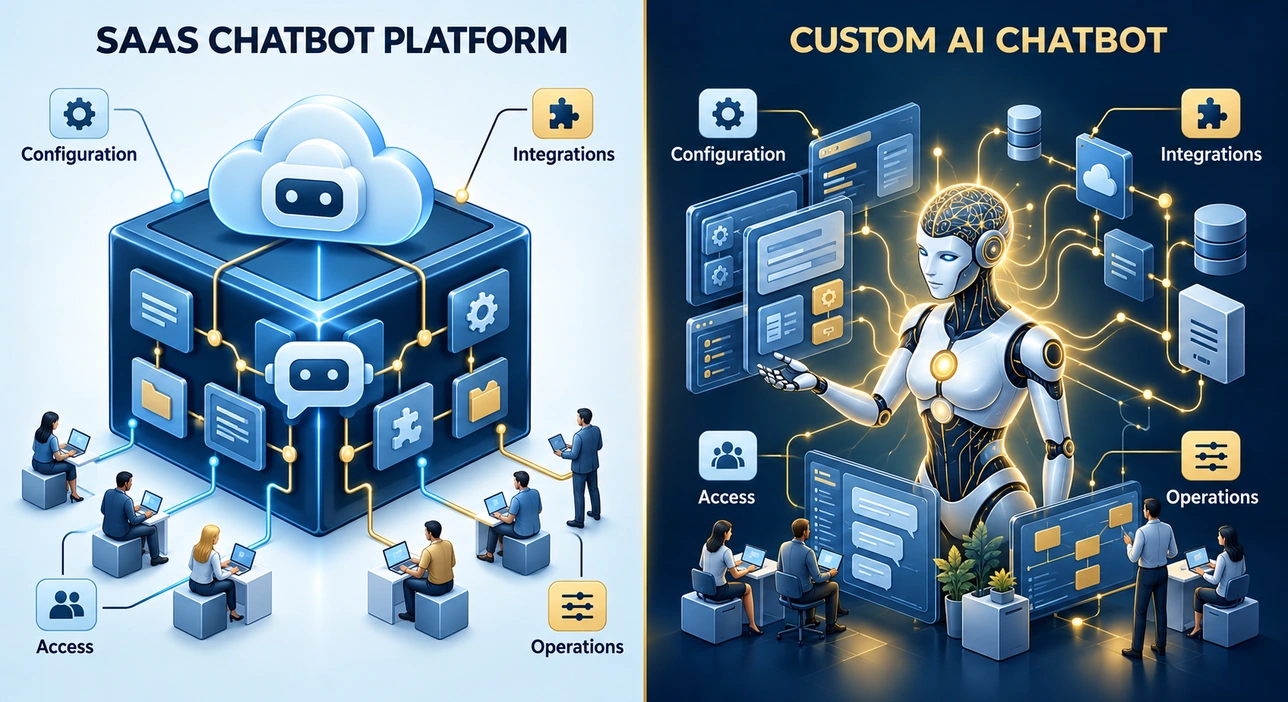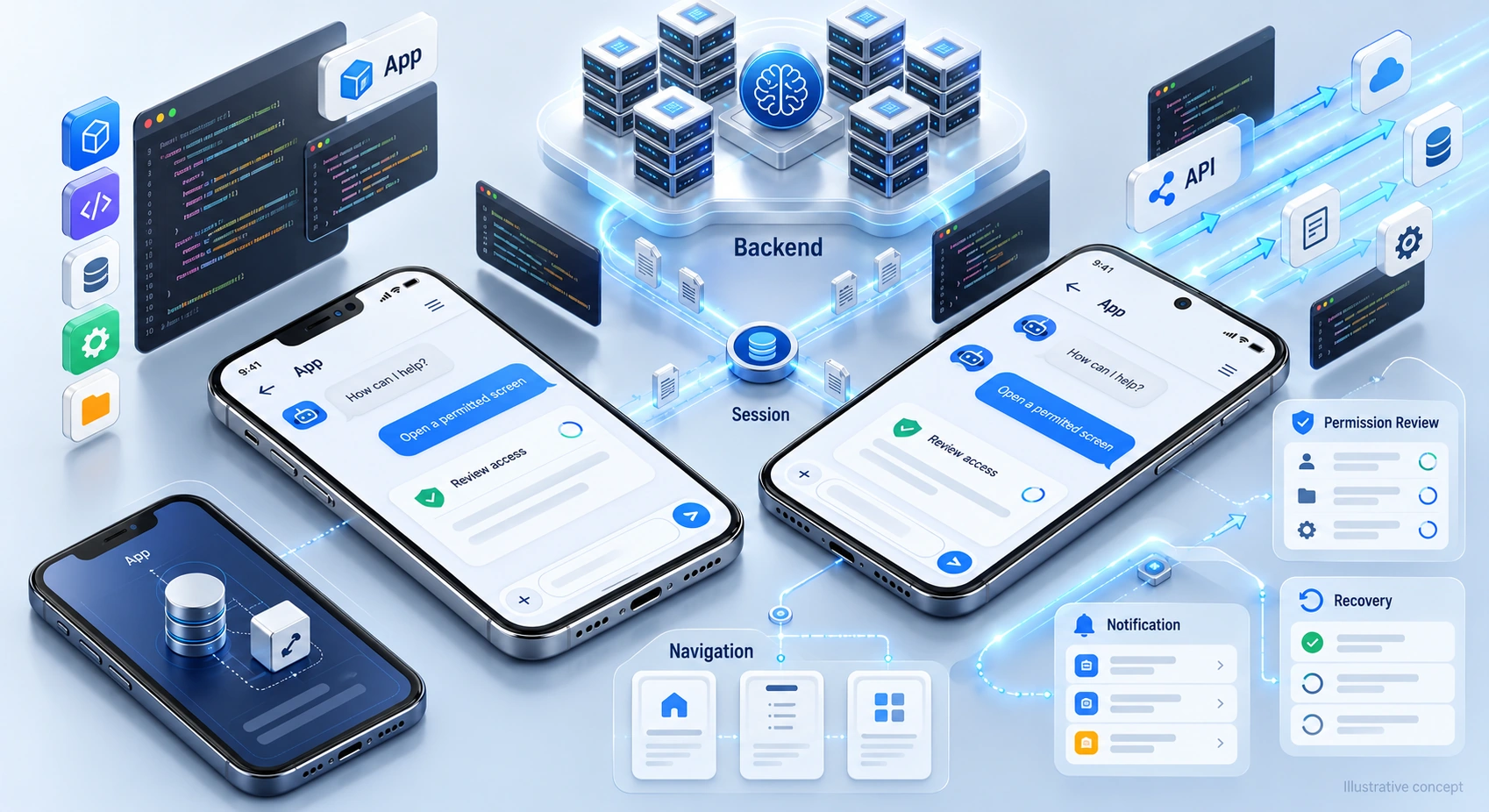

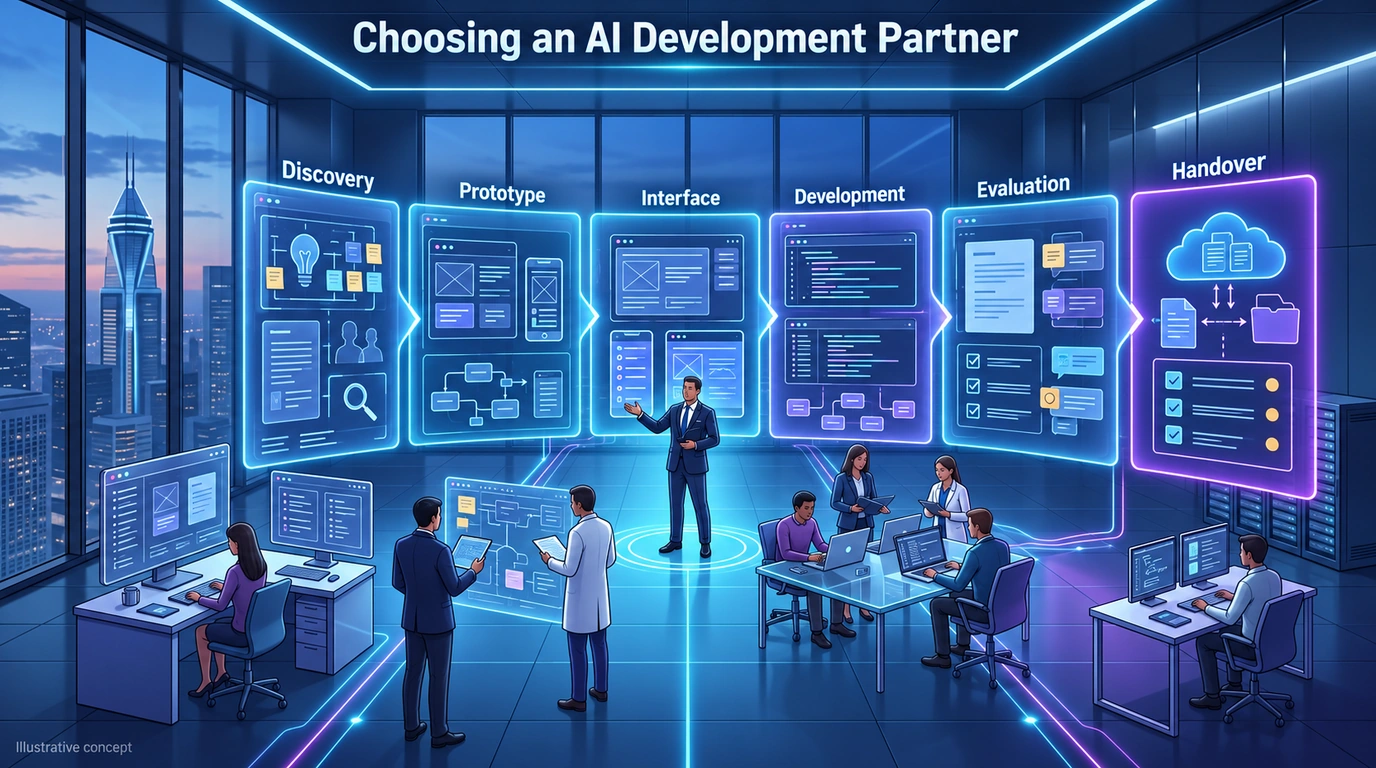
The decision about which company to collaborate with on AI projects is not something that can be decided based on portfolio comparison, rates, or product demos. To choose a potential AI app development company, you need to assess its technical skills, knowledge of enterprise business processes, security measures, transparency of costs and readiness to work with AI applications after the implementation.
A good AI development partner does not just attach an algorithmic model to an interface. It helps you find the right use case, prepare data, integrate the application into the existing ecosystem, and assess risks, performance, and maintenance in a changing business environment.
This guide offers a practical approach to selecting a reliable AI development company.
Quick Answer: How to Choose an AI Development Partner?
Evaluate potential partners in six categories: business expertise, AI knowledge, software engineering, data and security practices, proven track record in production, and business alignment.
Select two or three candidates, ask them identical key questions, compare the full scope of work, not just prices but also the price range, and even consider paying for a discovery phase prior to development.
The good partner must also be ready to justify the situation where AI is not needed. If a vendor suggests an AI solution to any problem, they probably focus more on technology itself than the business objective.
Evaluation of AI Development Providers
AI application consists of several elements – data, models, software, infrastructure, integration, and business process management. Thus, your evaluation should go further than just evaluating the skills of building a chatbot or training a machine learning model.
Business Understanding Comes First
Your first discussion should concentrate on your business issue.
A reputable firm will ask about who is responsible for executing the process, where delays or mistakes happen, who requires the application, what systems are included, and what success criteria apply. The firm should also consider whether traditional automation might address the issue more effectively or efficiently.
Avoid being persuaded by a supplier to use specific models, agents, or platforms before you understand your process. Your architecture should emerge from your business needs.
Relevant AI Expertise
There are many different areas of expertise within AI industry. The experience in developing a customer support chatbot does not make a firm capable of creating a computer vision, predictive maintenance, anti-fraud, or demand forecasting system.
Inquire about the approach proposed by the vendor and the alternatives considered. Based on the issue at hand, such an approach may rely on the use of classical machine learning, a foundation model API, an open-source model, retrieval-augmented generation, fine-tuning, or their combination.
The important thing is not how many different technologies the proposal includes, but rather the ability of the AI developers to assess their consequences.
Production Software Engineering
The model itself is just part of the enterprise application. The development partner needs to understand how to make sure that all interfaces, APIs, databases, authentication, permissions, integration, monitoring, and infrastructure will be secured.
This makes the difference between prototyping a model and deploying a production system. A prototype may use hand-picked examples, but the production system needs to manage missing data, unexpected queries, traffic spikes, outages, and actual users.
Review whether the company has the capability to deploy AI from experimentation through production. This process would include discovery, data analysis, modeling, software engineering, testing, launch, and ongoing improvement.
Data Engineering & Integration
The performance of AI systems will depend on the availability and quality of business data. The vendor should understand where the data is stored, whether it is correct, who owns it, how it can be accessed, and how often it is updated.
Data integration experience is just as important. In enterprise AI, there will often be connections to CRM, ERP, e-commerce, document management, customer service, and internal database systems. An apparently straightforward job can become very costly if these systems have inconsistent data or limited APIs.
Make the company identify such dependencies in the discovery phase. It will impact your budget and deadlines in many cases.
Security, Privacy, and AI Governance
The vendor may have access to sensitive documents, customer data, production systems, source code, and workflow processes. It is important that they clearly state how the data will be stored, transmitted, accessed, retained, and disposed of.
Generative AI applications are at risk of issues like prompt injection, sensitive data exposure, handling of unsafe output, and system permissions. The OWASP GenAI Security Project helps in addressing vulnerabilities faced by applications built with large language models.
Governance extends beyond cybersecurity. Applications that impact high risk would require human involvement, confidence scores, audit logs, explanations, and appeal mechanisms in case the AI-based decision-making process requires a challenge or reversal.
According to the NIST AI Risk Management Framework, risk management in AI is important throughout the lifecycle of the system. An appropriate vendor of enterprise AI can correlate their development methodology with the risk management approach.
Evaluation and Post-Launch Support
Classic software testing involves checking if certain input yields certain results. However, an AI system must also be tested on the grounds of its accuracy, relevancy, consistency, biases, security issues, latency, and practicality.
Consider how the vendor will develop representative test cases and what standards of performance can be considered acceptable. The claim of “highly accurate” becomes irrelevant in the absence of data, a measure, a threshold, and a practical scenario.
The process of evaluation is to continue even after the launch. Data keeps changing, new versions come from the provider of a model/prompt, the user behavior changes, and quality of production drops.
Practical Vendor Scorecard
Use the same scorecard for every shortlisted company.
| Evaluation area | Suggested weight | What strong evidence looks like |
| Business and industry understanding | 20% | Clear problem definition and measurable outcomes |
| AI and software engineering expertise | 20% | Relevant architecture and production experience |
| Data, integration, and infrastructure | 15% | Realistic assessment of technical dependencies |
| Security, privacy, and governance | 20% | Documented controls and risk-specific answers |
| Evaluation and ongoing support | 15% | Defined metrics, monitoring, and maintenance |
| Commercial and cultural fit | 10% | Transparent terms and effective communication |
Assign a score to each firm ranging from one to five, after which multiply their scores by their weights, respectively. Security, data ownership, or compliance needs may also be considered pass/fail criteria.
Questions to Answer Before Hiring
Ask every vendor on the shortlist the following important questions:
- Why is AI the correct solution to this problem?
- Which technical approach would you suggest, and why not other solutions?
- What kind of data will the application need, and how will you evaluate its quality?
- How will our data be stored, secured, and deleted?
- How will the application be integrated with our systems?
- How will model accuracy and business value be calculated?
- What is going to happen in case of model uncertainty, mistakes, or failure?
- Who will be working on the project, and can we speak with the technical lead?
- What is included/excluded in your price?
- To whom do the source code, data, prompts, workflow, and documentation belong?
- How will you support and maintain the application after the launch?
- How can we migrate the system in case of changing models/vendors?
The quality of the answer is more important than instant assurance. Good vendors will admit their uncertainties, explain the pros and cons, and list assumptions that need to be verified.
A good vendor will also ask you relevant questions, trying to learn about your users, your data, your existing process, the tolerance for error, your obligations, security needs, budget, and the desired ROI.
If your conversation still revolves around features and technology, the vendor may still not understand the true nature of your project.
Comparing Costs and Services
Lowest quotes do not always mean lowest costs.
One organization may charge for proof of concept, whereas another will charge for data preparation, application development, production environment, security, integration, monitoring, and support. Comparison of such propositions is not possible until deliverables and assumptions are harmonized.
A good proposal should cover business objective, scope, modeling strategy, data needed, integrations, evaluation method, time frame, responsibilities, pricing, what’s excluded, acceptance criteria, and services after go-live.
Compare Total Cost of Ownership
Not only the cost of development, but the use of the model, cloud hosting, data storage, software licenses, monitoring, maintenance, re-training, support, and migration in the future must be considered.
Initial cost savings might lead to high expenses if production conditions require change requests. Consult DigiWeta’s guide on cost and time budgeting for AI application development.
Choose the Right Pricing Model
Fixed-pricing suits those situations where the specifications, data, integration points, and acceptance criteria are known. Time-and-materials pricing suits situations where there needs to be some research and experimentation done.
The milestone pricing model usually works great for AI projects. The process can progress through discovery, proof of concept, MVP, and production deployment, where each step gives some evidence before moving on to the next investment phase.
Whatever your choice, make sure to ask for separate prices for the implementation and maintenance of your project.
Avoid Hourly Pricing
An hourly price rate does not necessarily mean a cheaper cost of the project. A mature team will find possible risks early, reuse the components that fit, and complete the project using fewer development iterations.
It’s always better to compare the cost to the scope, desired output, risks, and sustainability of the solution. The goal is not to get the cheapest engineering hours but to get an acceptable result.
Checking Previous Projects and Case Studies
Case studies are relevant only if they contain information that is relevant to your project.
An ideal case study is not always something related to a replica of the company. It could be about something of similar technical or operational complexity, for instance, the same kind of data, AI capability, integration environment, security requirement or scale of users.
Inquire about the vendor’s deliverable specifically. Since many projects are worked on by many consulting firms, cloud providers and internal teams, you must determine the company’s contribution, whether it was in terms of architecture, data preparation, application development, integration or some part of it.
Seek some measurable output like reduced processing time, reduced errors, increased response rate, increased capacity or reduced cost. A percentage without any baseline, evaluation period or business relevance means little.
It will also be wise to find out if the solution made it to the production level or if it was a proof of concept.
For a meaningful discussion, talk to past customers if the situation allows for that. Determine if the provider discussed any risks, managed the scope, provided functional documentation, helped launch the product, and responded well to issues.
When it comes to the demo session, ask the vendor to present unusual and unexpected cases along with perfect input data.
Making Final Decision
Now narrow down your list to only two or three qualified firms and provide them with the same set of information about the project. It includes the business problem, users, data, integration, security, budget considerations, and success criteria.
Then conduct a technical review meeting including business, engineering, data, security, procurement, and compliance representatives if necessary. The technical lead of the firm you are considering should describe the technical architecture, data flow, model approach, validation process, risks, and deployment.
Use Paid Discovery to Mitigate Risk
A short period of paid discovery may be far more useful than a series of sales meetings. This process may yield a data readiness assessment, proposed architecture, risk register, MVP scope, delivery estimate, and ROI hypothesis.
Also, discovery will illustrate communication style and decision-making.
In case technical feasibility is still uncertain, you may consider a proof of concept, where success and failure criteria have been predetermined. The test should provide an answer to a particular question, e.g., can the model achieve the required quality level with existing data.
Review the Contract
The contract should clearly stipulate the scope of work, acceptance criteria, payment terms, change management, intellectual property rights, security obligations, third-party services, support, termination conditions, data deletion, and assistance in transition.
To retain your ability to modify the system later, you should have access to source code, project data, prompts, configurations, deployment artefacts, and documentation. Dependence on one vendor/model/cloud may become very expensive.
Consider Cultural Fit
AI development is an iterative process with evolving evidence. You require a vendor that communicates effectively, questions flawed assumptions, documents decisions, and takes responsibility.
Beware of suppliers that give assurances about accuracy, make unrealistic promises, ignore data constraints, and consider deployment as the final step in the process. A good vendor will be confident without denying uncertainty.
Why Consider DigiWeta as Your AI Development Partner?
In our work with AI, we see the whole business system and not a process of model integration alone.
DigiWeta’s services in AI application development integrate AI consulting, data processing, software engineering, enterprise integration, cloud integration, and optimization.
We start by analyzing the required business result, available data, user workflow, technical infrastructure, and acceptable risks to understand what type of AI needs to be applied – generative AI, regular machine learning, RAG, or intelligent automation.
But businesses need to know what difficulties in AI application development are before choosing a vendor.
Frequently Asked Questions
How do I select an AI application development firm?
Assess its business acumen, AI expertise, software development capabilities, data and security management skills, production experience, pricing structure, and post-production support services. Check critical statements by having technical conversations, referencing case studies, testimonials, and a discovery process.
What should I expect from my AI development partner?
Seek a partner who starts with a business problem, provides clear explanations of technical approaches, assesses the risks in advance, defines success criteria, and has a realistic strategy for deployment and operations.
Should I consider the industry experience of the firm?
Industry experience is valuable due to a better understanding of workflow processes and compliance regulations. However, the related technical and operational experience might be just as valuable if the firm knows your use case.
Do I need to ask for a proof of concept?
A proof of concept is necessary if there are concerns regarding the quality of the data, performance of the model, integration processes, or technical feasibility. Define clear acceptance criteria beforehand.
How can I avoid AI vendor lock-in?
Ensure clarity of ownership, preserve access to source code and data, use standard interfaces when feasible, document the architecture, consider third-party licensing, and incorporate transition plans in the agreement.
What post-delivery support should be included?
Post-delivery support could encompass performance monitoring, handling incidents, evaluating models, security upgrades, optimizing, retraining, infrastructure management, and modifications to the model provider.
What is the biggest AI vendor selection mistake?
The worst choice would be picking a company based on a polished demonstration or lower cost without looking into the data readiness, security, integration, production engineering, and recurring costs and support needs.