
An AI product needs an operating model as well as a useful feature. Before setting prices, understand how usage, infrastructure and support affect costs, and how those costs relate to the value customers receive.
Application costs vary with architecture and demand. Conventional software also incurs hosting, storage and support expenses, so compare actual workloads rather than assuming every non-AI interaction is inexpensive.
AI features may incur model-provider charges or require infrastructure operated by the application team. Pricing units and included services vary. Measure the resources associated with each workflow, including retries and failures, and check the relevant provider terms rather than assuming every request has the same cost.
Growth can increase operating expenses as well as revenue. Test pricing and usage assumptions before expanding access, and plan how to respond if costs exceed expectations.
This guide explores pricing and usage-control considerations for AI application development solutions. It offers a planning framework rather than revenue forecasts or guaranteed margins. Review the AI application development lifecycle to place commercial decisions alongside product requirements, evaluation and delivery planning.
Discuss your AI product’s workflows, expected usage and operating requirements with DigiWeta. Define the engineering scope and budget assumptions before selecting pricing or capacity targets.
Chapter 1: Assessing a Free AI Tier
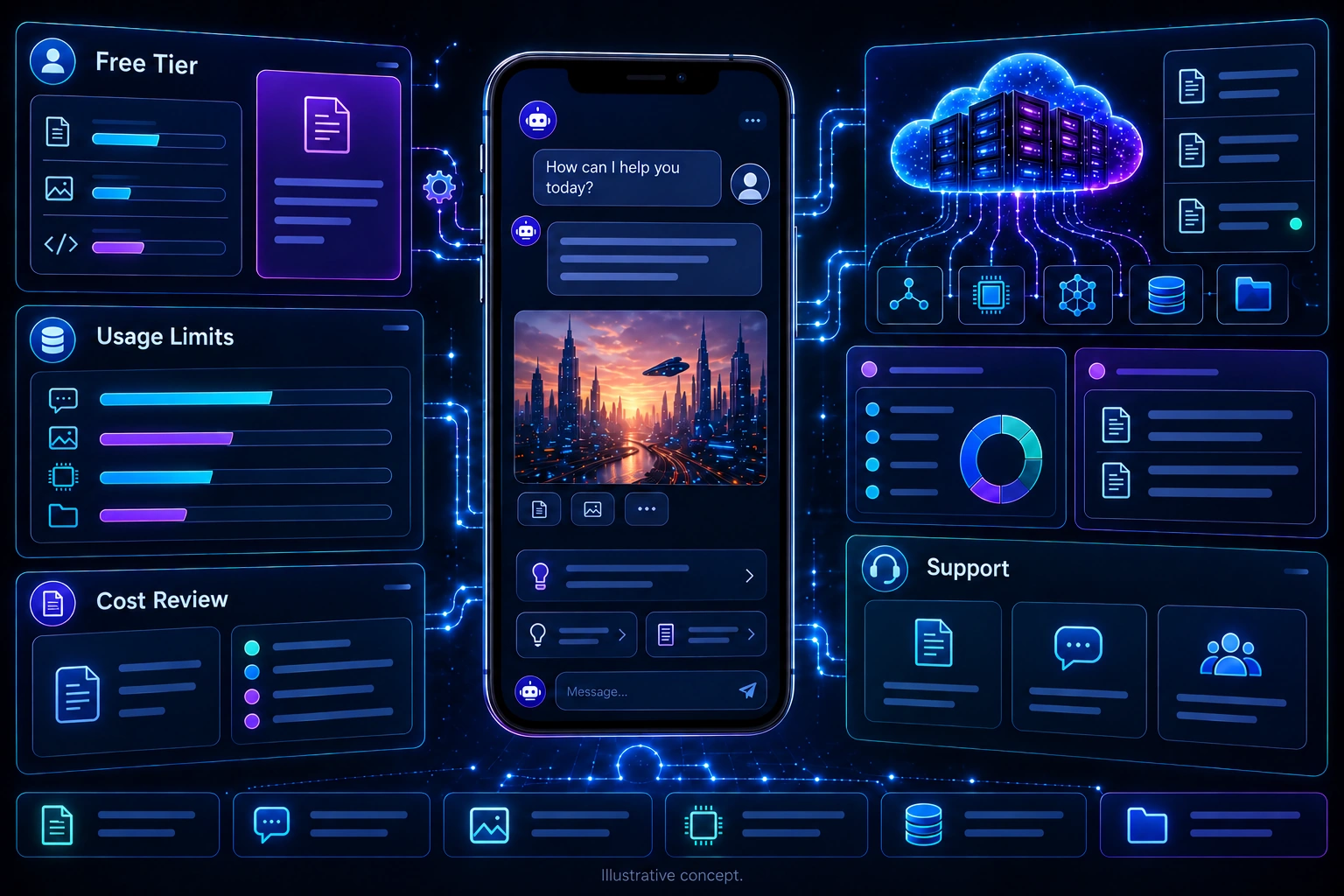
A free tier can help people evaluate a product, but its operating costs need a funding plan. Examine actual usage and revenue assumptions before expanding it.
Measure the Unit Economics
Estimate the cost and revenue associated with a meaningful unit of use, such as a completed workflow or active customer. Include model charges, infrastructure, support and payment-related expenses where relevant. Test the assumptions under different usage patterns. If revenue does not cover the relevant costs, additional volume alone does not resolve the gap.
Compare subscriptions, usage-based charges and limited free access against customer needs, measured costs and the product’s objectives.
Chapter 2: Freemium Access and Usage Controls
Freemium combines some free access with paid functionality or capacity. Its suitability depends on acquisition costs, conversion and ongoing usage. Define what the free tier includes and explain its limits before users rely on it.
Setting Clear Usage Limits
Set usage controls that match the product’s budget and service terms. Explain limits and enforce them consistently in the backend.
- The Workflow: Define how allowances are measured, when they reset and which actions consume them. Record usage reliably so customers can understand the remaining balance.
- When an allowance is exhausted, show a clear explanation and the available options. Do not promise unlimited paid access unless the service terms and operating model genuinely support it.
Clear allowances and upgrade choices are part of UX/UI design for generative AI apps. Avoid confusing paywalls or unexpected charges.
The “Bring Your Own Key” (BYOK) Strategy
In a bring-your-own-key arrangement, users connect credentials for a provider account they control. The product must explain what access is needed, how credentials are protected and which charges remain with the user or application operator.
- The Advantage: Some provider charges may be billed to the user’s account, but the application still has operating responsibilities. Review the service terms, credential handling and remaining hosting or support costs.
Chapter 3: Evaluating B2B Pricing
Business and consumer products serve different purchasing contexts. Neither category guarantees predictable revenue or a particular willingness to pay.
Business customers may assess workflow value, implementation effort, reliability and ongoing costs together. Use evidence from the intended customers rather than assuming that a claimed labor saving justifies a fixed subscription price.
Monetizing Custom Integrations
For enterprise offers, define the workflow and integration requirements before estimating implementation work or proposing commercial terms.
- White-Glove Onboarding: If setup or integration work is charged separately, document the deliverables, dependencies, acceptance criteria and responsibilities before agreeing on the fee.
- Per-Seat Licensing: Define what counts as a billable user and how changes in access affect the charge.
Compare product configuration with custom AI application development vs white-label solutions when customer requirements exceed the standard offer. Evaluate delivery and support responsibilities without assuming that customization guarantees larger contracts or complete data security.
Chapter 4: Usage-Based Pricing
Usage-based pricing can suit customers whose demand varies, but its usefulness depends on how clearly they can predict and control spending. Evaluate a credit model alongside subscriptions rather than treating either as universally more profitable.
Defining Credits and Charges
If using credits, explain their price, what each action consumes and any expiration or refund conditions.
- The Workflow: Define a transparent charging rule for each supported action. Record usage and handle retries, failed requests and cancellations consistently so customers are not surprised by deductions.
- The Profit Margin: Test the proposed pricing against operating expenses and demand scenarios. Credit pricing does not guarantee a margin; costs, discounts, failures and support needs can change the result.
Usage-based access may be worth evaluating for variable workloads. For example, when building an AI fitness app with computer vision, examine how often customers use the feature and whether charges are understandable before choosing an allowance or credit model. Do not equate a usage charge directly with the application’s total operating cost.
Chapter 5: Reviewing Operating Costs
Cost management starts with measurement. Identify which workflows consume resources and whether changes preserve the required quality and reliability. A lower model bill does not translate directly into a predictable change in overall profit.
Semantic Caching at the Gateway
Caching may be worth evaluating for repeatable requests, but reuse must account for permissions, context and information freshness. A similar question does not necessarily warrant the same answer. Measure whether a proposed cache remains appropriate and whether its operating costs justify the change.
Utilizing Smaller, Specialized Models
Evaluate models against representative tasks, quality requirements and operating constraints. A smaller model may be a candidate for some workflows, but lower price or size does not establish equivalent performance. Compare the full deployment cost and test results before changing production routing.
Assessing On-Device AI Costs
On-device processing changes where work occurs, but does not remove every application expense. Evaluate device compatibility, model delivery, updates, support and any remaining cloud dependencies when comparing it with remote processing.
Chapter 6: The Role of the Development Partner
Pricing, entitlements and usage records need to work together. Define how the application handles failed payments, delayed events, retries and cancellations, then test those scenarios. Monitor discrepancies so the team can investigate unexpected access or charges.
Choose a delivery partner based on relevant evidence, communication and the proposed operating responsibilities—not location or price stereotypes. The discussion of why US startups partner with AI app development companies in the USA offers questions to consider, but a premium fee does not guarantee sound architecture or financial success.
Plan Your AI Product with DigiWeta
A sustainable product requires a workable relationship between customer value, usage and operating costs. Revisit assumptions as the application and its audience change.
DigiWeta’s ai & ml app development discussions can connect application requirements with operating considerations. Define the intended workflows, usage controls, payment states and monitoring needs in the project scope. Evaluate proposed routing or caching changes against quality and cost evidence rather than promises of minimum expenses or maximum revenue.
Discuss your product requirements with DigiWeta and plan its usage controls, integration needs and operating responsibilities.
Frequently Asked Questions
Costs depend on the architecture and workload. AI features may add model usage or infrastructure expenses alongside ordinary hosting, storage and support. Review provider pricing and measure representative workflows rather than assuming a fixed cost for every interaction.
A free tier requires a funding and usage plan. Whether advertising, another revenue source or a paid tier can support it depends on actual costs and customer behavior. Monitor demand and avoid unrestricted access that the operating budget cannot support.
Freemium offers some access without payment and charges for defined additional features or capacity. Explain allowances, reset rules and paid options clearly. Enforce the published rules consistently, and avoid implying that a paid subscription is unlimited unless that is genuinely supported.
Semantic caching considers reusing a previous response for a similar request. Suitability depends on context, permissions and freshness. It needs evaluation; similarity alone does not establish that an answer is appropriate, and operating a cache still involves costs.
BYOK lets a customer connect a provider credential they control. Some model charges may then be billed to that account. The application must still address credential protection, permitted usage, support and any remaining infrastructure expenses. Explain the arrangement clearly.
A credit system assigns charges to defined actions and deducts them from an allowance or purchased balance. Explain the rules, including failed requests and expiration. Profitability depends on actual costs and pricing; using credits does not guarantee it.
On-device AI runs eligible processing locally rather than relying entirely on remote inference. Evaluate supported devices, model downloads, updates and remaining backend services. It changes the cost structure but does not make the entire product free to operate.
Business buyers may evaluate workflow benefits, integration and operating requirements, while consumer purchasing decisions may differ. Neither segment guarantees a price or retention level. Validate the offer with the intended customers and assess its costs before setting expectations.