

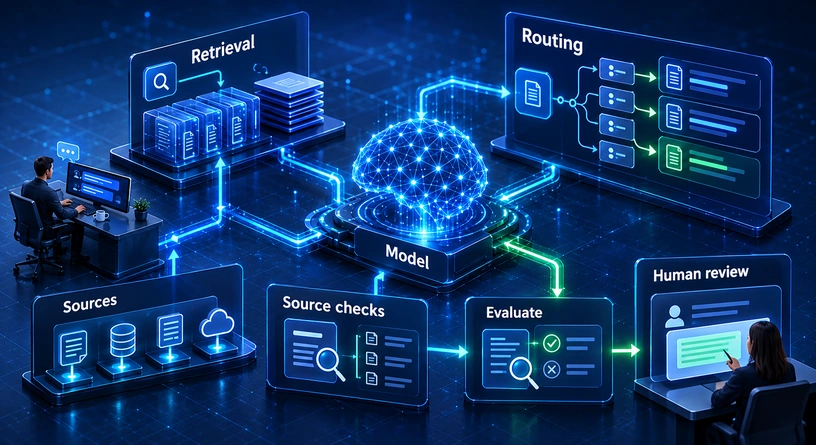
Generative chatbots handle varied wording, but fluent language does not prove accuracy. Support needs reliable sources, controlled actions, and a route to people. Rules and models can work together; neither is a complete answer on its own.
One important risk is hallucination: a response that sounds plausible but is inaccurate or unsupported.
Incorrect policies, invented product details, or unsafe advice can mislead customers and create operational or legal risk. The consequences depend on the situation, so involve appropriate reviewers. Do not promise that a particular architecture will prevent every error or assume a confident answer is supported by your records.
Managing these risks belongs throughout the generative ai software development lifecycle, from source preparation and testing to monitoring and incident response.
This guide explains ways to reduce unsupported answers and handle failures, not how to guarantee a hallucination-free system. To scope a project with DigiWeta, explore generative ai application development around your sources, controls, and evaluation needs.
Chapter 1: Understand Unsupported Answers
Language models use learned patterns and context to generate responses. They can produce convincing claims that available evidence does not support.
A model is not an authoritative database of your business. It may lack current policies, confuse similar products, or draw an incorrect conclusion from retrieved text. Give it appropriate context, but also test whether the final answer follows that context and whether it recognizes when the evidence is insufficient.
Use the current return policy and relevant order details for a policy question. If evidence is missing or unclear, explain the limit and offer a next step instead of inventing a rule.
Treat unsupported output as a risk to evaluate and manage. Set clear boundaries, review representative failures, and design fallbacks. Telling a model to be truthful is useful guidance, but it is not a guarantee of truthful behavior.
Chapter 2: Use Retrieval with Clear Limits
RAG supplies retrieved information to a model before it answers. Evaluate both retrieval and generation; either can fail, so RAG does not guarantee factual output.
Prepare Relevant Evidence
A retrieval workflow searches approved information for context relevant to the user’s question.
- Source Search: Use a retrieval method suited to your documents and queries. Apply access rules before returning content, and track which source versions are available.
- Context Selection: Check relevance, currency, and whether the material answers the question.
- Answer Guidance: Instruct the model to use supported evidence, distinguish uncertainty, and avoid inventing missing facts. Define when it should ask a question, decline to answer, or offer human help. Test whether it follows those instructions with conflicting sources and difficult requests, not only straightforward examples.
By using RAG to ground answers, you can supply evidence for the response. This reduces reliance on model memory but does not force correctness or eliminate invented claims. Keep source quality, retrieval tests, and answer review in scope.
Chapter 3: Evaluate Additional Output Checks
Retrieved material may be outdated, irrelevant, or misleading, and a response may add unsupported details. Test checks against these risks and adversarial input, including instructions embedded in sources. Access to evidence does not guarantee trustworthy output.
Guardrails can combine rules, validators, classifiers, and review processes. Each has limits and needs testing.
Review Answers Before Release
For some use cases, an additional check can assess whether the response is supported.
- Response Generation: The model drafts an answer using permitted context and the defined task instructions.
- Response Evaluation: A separate check may compare claims with source material, validate structured fields, or screen for content outside the assistant’s scope.
- Handle Failures: If the evidence is insufficient or a check fails, use a defined fallback. Avoid treating another model’s approval as proof of truth; evaluators can also miss errors. Measure false approvals and unnecessary rejections, and use human review where the consequences justify it.
Measure the effect of checks on response time and operating cost. A scalable LLM architecture should account for evaluation work without assuming one fixed latency penalty.
Chapter 4: Separate Answers from Actions
Answering a question and changing an account are different tasks. A cancellation request, for example, needs identity checks, applicable rules, and explicit confirmation before the supported system action. Do not let a plausible model interpretation substitute for permission or report completion before the system confirms it.
Use controlled workflows for actions and allow the language component to assist within those boundaries.
Keep Business Rules Outside Generated Text
Classify the request where helpful, but verify the required details and permissions before any action is submitted.
- Supported Actions: Use validated interfaces, parameters, access rules, and required approvals. Handle duplicates, failed requests, and uncertain outcomes. High-confidence intent classification alone does not make an action authorized or safe.
- Information Requests: Retrieve approved material, stay within scope, and disclose uncertainty. Route questions requiring missing information or professional judgment instead of inventing detail.
Hybrid design can separate responsibilities, but it does not guarantee safety. Sensitive uses need domain-specific controls, qualified review, and clear human routes. See the considerations for finance bots and healthcare solutions.
Chapter 5: Manage Context and Memory Deliberately
Follow-up questions may rely on earlier details, but context can become stale or ambiguous. Track the current subject and clarify references. Do not silently reuse old information after the user changes a requirement.
Define what conversation state is retained, where it is stored, and how access and deletion work.
Review What Each Request Needs
Sending more history is not always better. Decide which details are relevant to the current task and evaluate the effect of context choices on accuracy, privacy, latency, and cost.
- Answer Quality: Long or conflicting context can be harder to use. Test realistic conversations rather than assuming length always causes errors.
- Usage Cost: Repeated context can increase usage charges, depending on the provider and caching. Measure actual billing and response behavior.
Verify Compressed Context
A summary or selected state record can reduce repeated context, but it may omit or distort important details. Preserve critical verified fields, test updates, and allow correction. Compare these choices against the cost of custom chatbot dev while testing accuracy and latency.
Plan Grounded Customer Support with DigiWeta
Start with actual customer questions and sources that support reliable answers. Agree failure behavior and review responsibilities before launch. Evaluate the assistant as an operating service rather than promising one model or control will eliminate every risk.
Discuss generative ai development solutions with DigiWeta around approved sources, retrieval, validation, and controlled system actions. Define a test set, escalation rules, and maintenance ownership. Keep accuracy targets measurable and distinguish them from guarantees.
Ready to define your chatbot’s scope and checks? Contact DigiWeta to discuss grounded answers and practical evaluation.
Frequently Asked Questions
Models can generate plausible text without sufficient evidence, use outdated context, or misinterpret a source. Missing information is one cause, not the only one. Evaluate answers against authoritative material and define clear behavior for uncertainty instead of assuming fluency means correctness.
No. It supplies retrieved information that can help ground an answer, but sources may be wrong or irrelevant and generation may still add unsupported claims. Test source quality, retrieval, and final answers, and provide an appropriate fallback when evidence is insufficient.
They may apply rules, validate fields, compare claims with sources, or flag out-of-scope content. No single check catches every problem, and model-based evaluators can make mistakes. Measure failures and false rejections, and include human review where the consequences warrant it.
Verify identity, permissions, parameters, business rules, and required user approval before invoking a supported action. Keep these checks outside generated text. Confirm the result before reporting success, and handle retries or uncertainty without duplicating a transaction or account change.
Use the context needed for the task while respecting privacy and retention rules. Test full history, selected fields, or summaries against realistic conversations. Compare accuracy, latency, and cost; neither a longer prompt nor a shorter summary is automatically better.
Yes. Rules can control access and workflows while models interpret or explain information. Test their boundaries. Hybrid systems still need validation, monitoring, and approvals; deterministic code does not guarantee overall safety.
Compare data handling, provider terms, quality, controls, cost, and operating responsibilities for the intended use. A self-hosted model still needs security and maintenance, and a private cloud is not automatically isolated. Verify the complete data flow rather than choosing on a label alone.
Costs depend on sources, integration, access controls, evaluation, deployment, and support. Ask for a scoped estimate that separates initial delivery from running and maintenance costs. No price point purchases a guarantee that the chatbot will never produce an inaccurate answer.